Summer Scares Resources

Click here to immediately access the Summer Scares Resource page so that you can add some professionally vetted horror titles into your reading suggestions and fiction collections for all age levels.

Monday, November 19, 2012

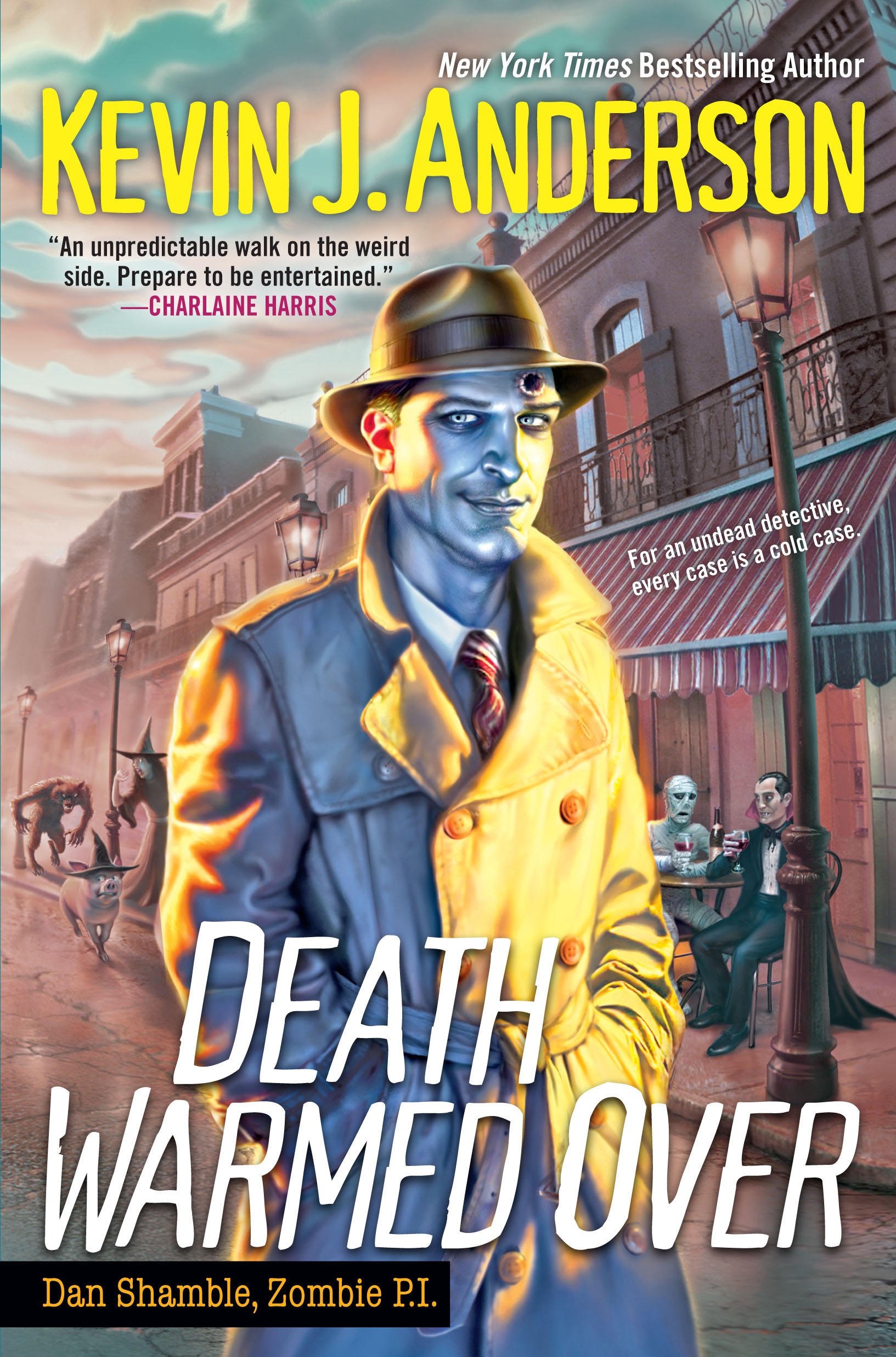
Review: Death Warmed Over--Dan Shamble, Zombie PI

Back in October, I read the first novel in the brand new comic horror series following zombie detective Dan Shamble, Death Warmed Over by Kevin J. Anderson.

Anderson is a best selling author of SF, mostly as part of shared worlds like Star Wars and Dune, and comic horror.  Click here for more.  So a new original series by Anderson piqued my interest, and then I read this plot summary from the publisher:
Ever since the Big Uneasy unleashed vampires, werewolves, and other undead denizens on the world, it’s been hell being a detective — especially for zombie P.I. Dan Chambeaux. Taking on the creepiest of cases in the Unnatural Quarter with a human lawyer for a partner and a ghost for a girlfriend, Chambeaux redefines “dead on arrival.” But just because he was murdered doesn’t mean he’d leave his clients in the lurch. Besides, zombies are so good at lurching. Now he’s back from the dead and back in business — with a caseload that’s downright unnatural. A resurrected mummy is suing the museum that put him on display. Two witches, victims of a curse gone terribly wrong, seek restitution from a publisher for not using “spell check” on its magical tomes. And he’s got to figure out a very personal question — Who killed him? For Dan Chambeaux, it’s all in a day’s work. (Still, does everybody have to call him “Shamble”?) Funny, fresh, and irresistible, this cadaverous caper puts the P.I. in R.I.P…. with a vengeance.
Now tell me how I could not immediately order this book?

The set up of the story tells you quite a bit about whether or not you would like this story.  Let me share a few details about the appeal though.

Death Warmed Over is first and foremost a noir, hardboiled PI novel.  Yes it is filled with the undead, but the tone, style, and frame is most firmly rooted in the work of the classic PI story-- think Raymond Chandler or Dashiell Hammett.  These are stories of loners, slightly outside the bounds of normal society, who are always on the side of justice but don't always follow the rules as they solve the case.  There are also usually femme fatales who jeopardize the PI.  All of this holds true for Chambeaux.

If you love zombies but do not like hardboiled mystery novels, DO NOT READ this novel.  It is more tongue-in-cheek about the mystery genre than the horror genre.

That being said, the world Anderson creates is well fleshed out.  Through Dan, we are introduced to how the world works now that the dead can rise.  One of the details I liked is that if you were murdered you have a much higher probability of coming back as a zombie or ghost.  This keeps Chambeaux quite busy with cases to solve and his own murderer to find.  As good a job as Anderson does here though, don't read this book if you are not willing to buy into the world he has created.

The characters are a mix of well developed and comic relief.  Anderson gives meat to Dan, his human lawyer partner, and his ghost girl friend as well as a few other key characters.  And, it is important to point out that even though the book is full of amusing, stock, undead characters, they are all used in surprising ways.  You think you know what the vampire is going to do or how the zombie is going to react, but in Anderson's crazy satire, you are probably wrong. As a fan of horror, I appreciated the way he honored the tropes but also injected something new and unpredictable.

And yes, the entire book is told with tongue placed firmly in cheek.  It is a satire of both horror and mystery, but it is also a statement on human nature (and how it doesn't change much one you are not human anymore).  It is about greed and corruption, but love and justice too.  There were moments when you are caught up in the seriousness of the story and then all of the sudden you are laughing out loud.

Overall I had fun with this novel.  It had enough detail and twists in the mystery to keep me reading, the world was developed enough for me, and the characters were interesting.  That being said, by the end I was growing tired of the "wink-wink" jokes and just wanted to find out who dunnit.  As always happens with me and comic horror, I had fun to a point and then I was ready to move on.

The next Dan Shamble book comes out at the end of December.

Three Words to Describe This Book: hardboiled, undead, comic

Readalikes: This is the perfect series for people who like the humor and world building in the Sookie Stackhouse series.  With both series I love the set-up, the characters, and the humor, but I have enough before the individual novels end. I like these kind of stories in small bits and pieces spaced out over time.

Don't forget what I said above about Raymond Chandler and Dashiell Hammett.  These are also excellent readalike options.

If you like the tone of Death Warmed Over you should also check out the various Blood Lite anthologies that Anderson has edited.

Also, click here to see a few of my other comic horror suggestions.

Finally, I am not sure why but the story reminded me of the Chew graphic novels.  Click here for details.  The Chew world is much more serious, but still has black humor and satire of Shamble's world.


Wednesday, November 14, 2012

Thursday, November 8, 2012

The Demise of Horror...NOT

While I am still catching up on everything else I ignored in my life in October, I saw this intersting commentary by Rose Fox, the SF/FSY/H editor at PW.  She is commenting on a piece in the Guardian. 

Click through to join the conversation.

Coming here next week...the return of reviews.

Thursday, November 1, 2012

Me on WPR yesterday

Here is the link of my appearance on the Joy Cardin show yesterday.  I am not until the last 10 minutes, but the entire hour was dedicated to Halloween.

31 Days of Horror: Day 32? A Not Quite Horror Post Script

John Skipp is a legend in the world of horror.  Back in the 1980s he helped to found the graphic, frenetic splatterpunk style of the genre.  But in the 21st century, he has made his name as a collector of stories old and new.

Specifically, he has been working with Black Dog to edit a line of anthologies.  His previous ones were on Demons, Zombies, and Werewolves-- all traditional, otherworldly horror monsters.

This time he keeps the scary coming, but it is the human monster he is concerning himself with.  Like the other books in the series, in Psychos, Skipp gathers stories by classic authors all the way up through brand new stories.  He also adds essays about the appeal of the monsters in his collection.

As a group, these collections are a very good choice for public libraries.  The essays explain to librarians and readers why these monsters continue to entrance readers, while the stories present a cannon for the topic.  There are so many great older stories that get lost over time, but in these collections they continue to live and give readers the scares they are looking for.  Having them paired with newer stories is a testament to the enduring power of the scary tale.

After I take some time off after this grueling month, I will be back with a review of Psychos as well as 2 more horror novels I read this month, but left out of the 31 Days marathon in favor of allowing you to hear from more authors.

But until then, here is Skipp writing an open letter to us librarians asking us to keep anthologies on the shelves.

**********************************************************************

ANTHOLOGY LOVE, AND OTHER STORIES

 by John Skipp


Dear Librarians --

THANK YOU SO MUCH! Because you’ve devoted your lives to it, you probably have an inkling as to how important it is.

But seriously? YOU HAVE NO IDEA!

Evidently, I was born to love books, too.

According to my older sister Linda, I memorized them before I could actually read them, telling my mom and sisters what was on the next page before they even turned it, because they’d read it to me the day before, and I’d hung on every word.

The first and greatest books I remember actually reading myself -- deciphering and internalizing those little black hieroglyphs -- were all by Dr. Seuss. Fantastic stories, with fantastic pictures, and wordplay that taught me the invaluable truth that words and ideas are fun to play with. A lesson I have stuck with ever since.

The ones that stuck with me hardest -- and have persisted, to this day -- were Yertle the Turtle and Other Stories and The Sneetches and Other Stories.

Without a doubt, the words and Other Stories were part of what made those books most memorable to me.

Because it wasn’t just how great it was to watch Yertle’s fall from power, lording it over all those turtles he stacked beneath him just to be all high and mighty. And it wasn’t just about whether it was better to be a Star-Bellied Sneetch or a Sneetch with no stars upon thars, and how stupid that whole status conflict was.

It was also the fact that there were all these other great stories, sitting right there, for me to read. IN ONE BOOK! There was the story of the haunted pants, with no one inside ‘em, who turned out to be just as scared as you. There was the story of the north-going Zax and the south-going Zax,
who had a whole world to move around in, but refused to get out of each other’s way. There was ‘‘The Big Brag’’. There was ‘‘Too Many Daves’’. It was crazy, how many stories he had!

It was a natural leap to Edgar Allan Poe, who in one book -- Tales of Mystery and Imagination -- managed to tell me dozens of astonishing stories, each one wilder and more haunting than the last.

So now I’d found two authors I dearly loved.

And that was where anthologies came in.

Living in Buenos Aires, Argentina, at nine years old in 1966, I had a choice of the books in my school’s well-stocked library, the U.S. Embassy’s commissary, and the more-than-occasional English-language books hanging from clips on sidewalk stands. This is how I stumbled across the British publishers Pan and Fontana, who were both putting out their own takes on what they regarded as the Greatest Horror Stories.

And then there was Alfred Hitchcock, whose films I’d never seen. But boy, did that guy know how to pick ‘em! He’d walk in with a droll, funny intro, and then unleash a dozen crazed tales or more. My favorite was Stories They Wouldn’t Let Me Do On TV, which first introduced me to the provocative notion that there were stories other people didn’t want you to hear.

Between Pan, Fontana, and Sir Alfred himself, I was introduced to the early cream of the dark literary crop. What we refer to as the classics. It was my formal introduction to the genre. And it utterly changed my life.

And this was the thing: suddenly, I was meeting waves of writers through their stories. The slow nightmare unearthliness of M.R. James, Arthur Machen, and Nathaniel Hawthorne. The wry creepiness of Saki, John Collier, Joan Aiken, and Roald Dahl. The more muscular dread of early Ray Bradbury, Robert Bloch, and Anthony Boucher.

So many great writers. So many incredible stories. Such a universe, opening wide.

All seemingly aimed directly at me.

Now let’s fast-forward more than 40-some years. And suddenly, I’m the guy who gets to share stories.

Have you ever made a mix CD for someone you love, where you sat down with all of your favorite songs and assembled a playlist that rocked and flowed, taking your intended on a guided trip down a path paved with nothing but astonishing gems from all up and down the spectrum, in the hope that they’ll be as blown away as you are, and be rendered aglow because they know that you made it just for them?

That’s pretty much how I look at editing anthologies.

In so many ways, short stories are like songs. They step up, immediately lay down a mood and a rhythm and a voice. Take you succinctly where they’re going. And drop you off, neat and complete, at the end.

A great short story crystallizes life’s enormity into a handful of pages, bringing everything that matters (for the purpose of the tale) into sharp experiential focus. It can be fast, slow, funny, sad, shocking, haunting, blunt, or piercing. It can be unspeakably beautiful, or uglier than sin.

It can do anything it wants, so long as it does it right.

When I edit an anthology like PSYCHOS -- or the previous Black Dog volumes, ZOMBIES, DEMONS, and WEREWOLVES AND SHAPESHIFTERS -- my mandate is clear.

1) To find definitive classics that helped lay down the foundation of the genre. (Largely dating from the late 1800s to, let’s say, the 1960s.)

2) To bring in the equally-pivotal works of the 1970s and 80s -- when all the walls came down -- up till now.

3) To present original stories from this booming-as-we-speak Golden Age, in which some of the best short fiction I’ve ever read is currently being produced.

4) To put it all in context, for a modern audience. Draw the lines from here to there, pointing arrows into the future.

So yes, the little kid inside of me can’t believe that he’s been able to assemble vintage Poe, Lovecraft, Saki, de
Maupassant, Bradbury, Bloch, Sturgeon, ‘‘The Monkey’s Paw’’, ‘‘The Most Dangerous Game’’, and ‘‘The Devil and Daniel Webster’’ into his mix. All the stories I grew up on. It’s a staggering thrill.

Add to that a pop culture A-list of titans -- Thomas Harris, William Peter Blatty, Neil Gaiman, George R.R. Martin, Max Brooks, Lawrence Block, Chuck Palahniuk, Charlaine Harris, and Stephen King -- and my hit list goes through the roof.

On the literary end, there’s Angela Carter, Leonid Andreyev, George Saunders, William Gay, Jim Shepard, and Christopher Coake. All spectacular. All blowing past the narrow parameters of genre.

Stir in the amazing authors who came of age with me, in the 80s and 90s: Joe R. Lansdale, Jack Ketchum, Robert McCammon, David J. Schow, Kathe Koja, Poppy Z. Brite, Robert Devereaux, Elizabeth Massie, Adam-Troy Castro, Steve Rasnic Tem, Francesca Lia Block, Bentley Little, Brian Hodge, Karl Edward Wagner, Douglas E. Winter, and Richard Christian Matheson, just for starters. Smashing through the barriers of what genre could be.

Only then do I get to the astounding new voices, as yet unsung, that are helping define this fresh century’s promise of further ground-breaking excellence: Cody Goodfellow, Laura Lee Bahr, Amelia Beamer, Carlton Mellick III, Mehitobel Wilson, Mercedes M. Yardley, Eric Shapiro, Scott Bradley and Peter Giglio, Nick Mamatas, John Gorumba, Ed Kurtz, Tessa Gratton, Weston Ochse, J. David Osborne, Violet LeVoit, Jeremy Robert Johnson, and so many, many more that I only wish I could list them all.

My goal as an editor is to cherry-pick the great stuff, give you only the best of the best. Or, at the very least, present to you my personal favorites, in a way that both satisfies and flows.

Taking you on a series of epic trips. And thereby letting you know I love you.

Because that’s what those early anthologies did for me.

In closing: PLEASE KEEP OUR BOOKS ON YOUR SHELVES FOREVER, OKAY? Because that’s how we keep the torch alight.

And thank you thank you thank you.

Wednesday, October 31, 2012

31 Days of Horror: Day 31-- Guest Post by Lisa Morton


Happy Halloween! We have hit the final day of 31 Days of Horror and today I have a treat.  Lisa Morton, author of the brand new Trick or Treat?: A History of Halloween is our guest poster today.  As I wrote about this book in Library Journal:
"Finally, for nonfiction fans, Lisa Morton’s Trick or Treat: A History of Halloween (Reaktion, dist. by Univ. of Chicago. 2012. ISBN 9781780230474. $29) covers the history of Halloween from its ancient Celtic roots to its stunning growth in global popularity in the 21st century. Morton is an accomplished horror short story writer, and her ability to draw readers in quickly and keep them turning the pages shines through in her nonfiction as well. Lavishly illustrated, this solidly researched and concise work is fun to read and a great choice for readers who want to know why we seek out the scary each October. Lisa is joining us today to talk about her love of Halloween."
Lisa also posted this list of "Ten Classics of Halloween Fiction" over on Monster Librarian's blog this week. 

Before I go though, just a quick note to tell you I will be back tomorrow with a very special bonus 32nd day of 31 Days of Horror.  Until then, enjoy the holiday.  I will be out with my little Indian Jones and zombie rocker scamming for candy.

********************************************************************
Why I Keep Writing Books About Halloween
By Lisa Morton


Back in 2011, when an editor at the fabulous Reaktion Books approached me about doing a Halloween book for them, I was ecstatic. Not only was I fan of Reaktion Books’ beautifully-designed and slightly irreverent pop culture histories – I’d gobbled up everything from Spiders to Ice Cream – but I’d also just finished work on the 2nd edition of my Halloween Encyclopedia. I’d spent hundreds of hours poring over everything from eighteenth-century folklore collections to modern websites, and had crafted the most comprehensive collection of Halloween facts ever published. I thought I surely knew everything it was possible to know about the holiday. It’d be a breeze to write a narrative history, right?

I wasn’t just wrong – I was wrong in a way that meant I was in for a long string of surprises.

Here’s one of the (many) things I love about Halloween: It’s what folklorist Jack Santino calls “polysemic”, meaning it was many meanings. Look, for example, at the decorations that line store aisles every October, and you’ll see Halloween connected with harvest, with candy, with death, with comedy and whimsy, with children, with teenagers, with adults, with animals, and of course with fear. What started thousands of years ago as a Celtic New Years’ celebration called Samhain has transformed from that three-day festival (complete with feasting and spooky stories) to a somber religious observance of the dead to a raucous night for young people to party and tell fortunes to polite Victorian gatherings to an evening of destructive prank-playing to a “masked solicitation ritual” for young children called trick or treat to a night when adults challenge their fears in the relative safety of large-scale haunted attractions.

I knew all of this when I started work on Trick or Treat?: A History of Halloween, and given how Halloween seems to constantly shift and change, I expected to find a few new facts that had appeared in just the brief time since I’d finished work on The Halloween Encyclopedia.

What I didn’t anticipate was a veritable explosion in Halloween’s global popularity.

When my editor at Reaktion suggested broadening the book’s examination of the global celebration, I thought, Well, that’ll be easy, because it’s really an American holiday. Outside of its past in the British Isles and All Saints’ Day observances, I didn’t expect to find much else.

What I did find was that Halloween had become a gigantic U.S. export just since 2006. Here a few of the amazing facts I came across:

* One major British supermarket chain (Waitrose) reported a whopping 676% increase in sales of large pumpkins from 2009 to 2010.

* Another British supermarket chain (Tesco) didn’t even start stocking adult Halloween costumes until 2009.

* In 2007, the popular Belgian amusement park Walibi added Halloween “Fright Nights” (converting amusement parks to Halloween attractions has proven hugely successful throughout Europe over the last few years)

* A sociologist has stated that, as of 2009, Halloween has “become part of the cultural capital (and hence of the identity) of a generation of young Germans.”

* In Ukraine, where a pumpkin traditionally symbolized a woman’s rejection of a suitor (to “hand you a pumpkin” still means turning down a deal), Halloween is celebrated by large dance performances to Michael Jackson’s Thriller.

* Despite being condemned by both the Moscow Department of Education and priests from the Russian Orthodox Church, a 2010 Russian newspaper article described Halloween as “growing exponentially” there.

* Halloween is not celebrated in the Middle East, but a 2009 WikiLeaks document detailed a decadent Halloween celebration among wealthy young Saudis, complete with costumes and drinking.

* A 2006 article in China Daily suggested that young Chinese people were starting to prefer Halloween to their own Yue Laan – the “Hungry Ghost Festival” – because Halloween was more “fun” and lacked the genuinely frightening elements of the native festival.

By the way, Halloween hasn’t been universally embraced – major French newspapers declared the holiday there “pretty much dead” in 2006, thanks to anti-American sentiments and a preference for the quieter, traditional observance of All Saints’ Day (which is celebrated with visits to cemeteries). But that rejection of the holiday is definitely the exception, not the rule.

So…why is the world suddenly embracing Halloween? The answer seems to be mainly split between two factors: 1) American retailing, as worldwide chains like McDonald’s and Disney employ Halloween merchandising; and 2) American culture, as movies like The Nightmare Before Christmas and Halloween episodes of American television series (especially sitcoms – the world seems to love American sitcoms) are viewed around the globe.

I would argue that Halloween speaks to something deeper in us as well, and that those exports just served as the gateway drugs. Halloween inaugurates that time of year when we’ve brought in the harvest but secretly dread the arrival of long winter nights; it tells us that we can survive the darkest months by treating our fears in a playful manner (the fact that Halloween has found very
little support in the southern hemisphere, where the seasons are reversed, I think lends credence to this notion).

At this point I’d like to think I’m done with writing about Halloween (in the non-fiction sense, at least), but something tells me that it’ll change again in a few years, and some publisher will make me an offer I can’t refuse, and I’ll be pulled back in. I’ll probably think, Hey, piece of cake – I know everything about this holiday, right?

And I will forget again how often I’ve been wrong about that very thing.

copyright © 2012 Lisa Morton
lisa@lisamorton.com
http://www.lisamorton.com

Tuesday, October 30, 2012

31 Days of Horror: Day 30-- JournalStone Part 4


This is part 4 of 4.

I am letting the managing editor, Norman Rubenstein have the final word for the day.


After graduating from Northwestern University with a dual B.A. degree in Philosophy & Political Science and then from Loyola University of Chicago School Of Law with a J.D. degree, Norm spent over twenty years as a litigation attorney, then was appointed as an Administrative Law Judge for the city of Chicago, where he presided in thousands of trials and hearings.
Norm also organized and presented a number of rather large science fiction conventions in conjunction with the BBC for their Doctor Who television series and was featured on a nationally televised segment of the Entertainment Tonight TV show back in the 1980's. He went on to co-produce ten stage plays including one, Murder By Misadventure, that ran upon London's famed West End for six months, and a world premiere of an A. R. Gurney play, The Fourth Wall, starring George Segal and Betty Buckley in Chicago.
Norm is an Active Member of both the Horror Writer's Association (HWA), and of the International Thriller Writer's, Inc (ITW). Norm has been a member of and then served two years as Chair of the HWA’s Stoker Additions Jury, completed a stint as the Chair of the 2011 HWA’s Stoker Anthology Jury, and is currently in his second year as Co-Chair of the HWA’s Bram Stoker Awards® Committee.

Norm has seen well over one hundred of his Horror & Thriller Genre book and film reviews purchased and published over the past seven years. Norm has written a regular column for Fear Zone "Macabre Musings," is and/or has been a regular reviewer for Horror World, a regular columnist for Shroud Magazine, and also, is a reviewer for Cemetery Dance Magazine, Dark Scribe Magazine, Hellnotes, and Dark Discoveries Magazine, as well as serving a stint as the Reviewer for the Pod Of Horror podcast hosted by author and professional radio host, Mark Justice, and is a frequent convention speaker, panelist, and moderator. He is currently the Reviews Editor for both Hellnotes and Dark Discoveries Magazine.

Norm has had extensive experience working freelance as an Editor for a number of Specialty Presses, including Bloodletting Press, Cargo Cult Press, Centipede Press, Dark Regions Press, Thunderstorm Books, Genius Publishing, and is currently the Senior Managing Editor at JournalStone Publishing (http://journalstone.com). Norm’s personal website is http://www.macabremusings.com.

As an author, Norm is proud to be a contributor to the recently released and multi-award nominated, David Morrell and Hank Wagner edited hardcover Anthology, Thrillers: 100 Must Reads from Oceanview Publishing. Norm’s very first fiction short story -- “The Closet” -- co-authored with noted Canadian author Carol Weekes, appears in the recently released anthology Fear Of The Dark, by Horror Bound Magazine Publications. Norm’s second short story, “The Widows Laveau,” co-written with author and publisher, Steven Booth, appeared in the recently released, prestigious charity Anthology, Horror for Good. 


**********************************************************************

Why I/We Love To Publish Dark Fiction

Norman L. Rubenstein


I’ve been asked to try and describe, from a publisher’s point of view, what makes us love to publish dark fiction. In a direct sense that is easy. Having worked for a number of relatively small, independent presses—all publishing in the horror and dark fiction genres—the short answer is: because we all love the genre. It is a universal trait keenly felt by every publisher I’ve ever worked for and with. To dig any deeper, not being a psychic, I can and shall only expound upon my own, individual experiences and motivations.


As the eldest of three children, I was raised in a household that strongly encouraged reading. We were read to virtually every afternoon and most evenings before we were old enough to read on our own and the “magic” seemingly contained in the shapes and squiggles contained in those books was a secret I was determined to uncover, with, again, the assistance and support of both my parents. I thus mastered the basics and was reading at age 4 and my parents also took us to the local library every other week so we could stock up on books. The library was where I discovered Jules Verne, Edgar Allan Poe, H. G. Wells, Ray Bradbury, and Isaac Asimov, and, from there, the many other authors that lead from them. While my parents made certain that I was exposed to a wide range of literature, I soon realized that I found the vistas and imagination of science fiction and fantasy as especially entertaining, second only to the thrill I felt in reading horror fiction.


Though my parents strongly encouraged us to read, they never prohibited us from watching television or going to the movies. As a youngster I can remember being extremely influenced by and an avid watcher of three shows that were presented on Chicago TV at the time, Science Fiction Theater, Boris Karoff’s Thriller, and The Twilight Zone. All three were anthology series where many of the same authors I was reading wrote (for the most part) very entertaining and frightening original stories and adaptations of their short fiction to the delight of an entire generation of avid viewers, myself certainly included.


I never outgrew that initial fascination with the unknown and the terrifying and have always retained the same wonderful frisson of fright, of delicious chills, that such fiction uniquely provides. I do not consider this fascination with dark fiction to be an addiction, in that an addiction is normally deemed detrimental, it can be fought—it can be cured. Yet my, and others, fascination with horror fiction isn’t detrimental (at least assuming the person isn’t insane and not a sociopath) nor would any of us wish to wane our exposure to such material.


As I’m sure many other have and will point out, horror is deemed the basis of one of mankind’s earliest stories—the tales of the unknown, inexplicable monsters waiting to devour those who dare step away from the protective light of the fires or lurking in the night just outside the communal cave or huts. Some would say, with some justification, that horror—that fear of the unknown or of monsters, whether real or imagined—is hardwired into the human consciousness and is a means for self-preservation. Whether or not this is true, it is unmistakable that horror evokes one of our most basic and strongest set of emotions and is a very powerful influence. What may have caused us to experience such emotions may have evolved as we have in certain respects, and what may have originally been required as a serious warning now may be employed primarily for mundane purposes of entertainment, but the experiences remain desirous for a great many of us.


That being the case, there is a large, ready and anticipatory audience always hungry for new, quality fiction that will provide them with all the rush of emotions and endorphins that a good scare initiates, while granting just the right amount of willing suspension of disbelief so that they can be sufficiently affected by the fright/terror inducing story they are reading, while at the same time they remain comfy and safe in their homes, secure at some basic level that the bogeyman cannot really get them.


It is for these people, which specifically includes those of us who work at/for a dark fiction/horror publisher, that we strive to publish. In common with virtually all publishers, we try and publish works that we believe will appeal to the audience(s) we are striving to connect with. We, again, as with most publishers, rely upon members of our staff along with the president of our company, to sift through many submissions to find the works that we believe are among the best and will provide the most entertaining experience in concert with the previously mentioned raison d’être of horror literature: to cause feelings of fright/terror/unease/horror in the reader. It isn’t an easy thing to do well and effectively, and all kudos and thanks to those authors who show skill and flair in doing so.


As a short postscript: In light of the passing of a unique and masterful talent of multiple genres, but one deservedly best known for his dark fiction, I suggest that you all join me in selecting a favorite book or story of the late Ray Bradbury and reading it this Halloween. There are certainly a surfeit of titles from which to choose from the prolific and brilliant author. Perhaps due to the proximity of the holiday and/or for those of you with children, you might wish to read/share The Halloween Tree or perhaps From The Dust Returned, or The Homecoming. It just now seems fitting to, at least unofficially, make the late Mr. Bradbury’s self-proclaimed favorite holiday, Halloween, the date upon which to remember and do homage to his genius.