Summer Scares Resources

Click here to immediately access the Summer Scares Resource page so that you can add some professionally vetted horror titles into your reading suggestions and fiction collections for all age levels.
Showing posts with label guest post. Show all posts

Wednesday, November 1, 2023

31 Days of Horror: Day 32-- Promoting Horror All Year Long with Lila Dennning

I wanted to remind you AFTER October Horror is still worth promoting. As reported in Publisher's Lunch in January 2023, Horror is up 79% in sales as its own category over the previous 2 years. 

While we see an increase in seasonal readers in the Fall, there is a steady amount of all year long Horror readers, and that number is growing.

I asked my colleague Lila Denning, a national expert on Book Discussions, and part of the HWA's Library Team, to share how she highlights Horror all year long.

Even if she does not convince you, at the very least, leave those displays up for another week as people trickery in who meant to read a Horror title this fall but forgot. They will be relieved that you are sill thinking of them.

Thank you to Lila for helping out here. To read other guest posts by her, click here. And now, Lila Denning:

💀💀💀💀💀💀💀💀

It’s the day after Halloween and you may be tempted to set aside the horror titles in your collection until next October. You may be sad that spooky season is over as we head into the winter holidays. But remember that it’s always spooky season because horror circulates all year and given the current rise in popularity, it is part of good patron service to include it in your passive and active readers advisory outside of Halloween season. By expanding how you think about genre and blending similar themes, you can continue to market horror to your patrons throughout the year.

Winter is dark, silent, cold and kind of scary. Look for those horror novels that take place in the winter and the snow. Lists like this one on Goodreads can guide a search of your library’s collection. There is also at least one winter or winter holiday themed short story collection released every year. Some readers may appreciate a small break from the push of joy and family visits to dive into something scary.

A theme like “Not Such a Happy Home” could include domestic thrillers, psychological suspense, haunted houses, and dysfunctional families. This would allow you to blend mysteries, suspense, and horror on one book display or online list. There are plenty of books with broad appeal that could be included. Using generic terms like murder for the title of the list or display, is another way to expand beyond one genre.

Witches cross genres – add paranormal romance, historical fiction, and horror. There are also creatures like shifters that appear in more than one genre. Add a sign that says “Shift Into Summer” and you can help circulate those titles in that time in between spring and summer. Of course, human monsters like serial killers appear in a variety of books, movies, and TV series.

When movie or series gains popularity during the year (studios don’t save all their horror features for October), remember to put up a display or list with read-alikes for that title. Bird Box was released in December 2018 and was a huge success. Netflix released Wednesday in November. That series could be used to promote your backlist YA titles in addition to adult books. Harness the energy of things with momentum in popular culture to draw attention to your backlist horror.

Springtime is the season for baby birds, melting snow and…folk horror. The movie Midsommer demonstrated that people will flock to stories set in rural places about folk religions, paganism, and witches.

Don’t forget about scary beach reads. Not everyone wants light, humorous books while they are on vacation. I have book displays with horror empty out in the summer as patrons take them down the road to the beach to enjoy as they sit in the bright sun. One of the more iconic summer creature films is Jaws. Recently there have been some great beach/ocean/shoreline related horror released that could jump start a summer display – What Kind of Mother by Clay McLeod Chapman and Whalefall by Daniel Kraus. Additional evidence for the allure of scary books in the summer is the number of big mystery and suspense titles that are released every summer.

Speaking of summer, don’t neglect horror on your YA and youth summer reading suggestion list. There are a lot of great middle grade and YA horror titles available. Seeing their favorite kind of books promoted in the library could be just what a child needs to draw them back into reading and the library. The Bram Stoker Award nominees are an excellent place to start.

There are also juvenile fiction titles and picture books that can be suggested to help younger fans keep reading while school is out. The Horror Writers Association (HWA), in partnership with United for Libraries, Book Riot, and Booklist present Summer Scares every year. Three adult, YA, and middle grade titles are selected and can be worked into book clubs and displays. The most up-to-date resource page is here. Use these titles and the annual programming guide to make next summer a spooky one.

Hopefully, these ideas will give you a jumpstart on adding horror to your displays and lists all year. While Halloween is a wonderful celebration of the dark and spooky, horror can easily be worked into readers advisory year-round. If you are one of the library workers who loves horror, take it forward into every month.

Monday, February 17, 2020

Women in Horror Month: The Women Are Coming For You. Are You Ready?


As I mentioned in this post, Dead Head Reviews is running an excellent series of Women in Horror Month guest posts.

Sunday, they featured my piece entitled: "The Women Are Coming for You. Are You Ready?" It is essentially my assessment of the genre's best first novels over the last few years and the trend I have seen toward women writing a larger number of the best of these novels. I didn't even have time to dig into the novella and short story form, but there is evidence there [both with awards and critical acclaim] that women are also taking over. In general, women, and horror readers, are not longer worried about female authors being unladylike, rather they are starting to find their own voices in horror, and those voices are original and terrifying.

Click here to see my essay and here to read more in Dead Head Reviews wonderful series. They aren't just providing lists of women authors to read. They have curated interesting and useful information and content about the state of horror today, from the female perspective.

I am proud to have been a part of it.

Dead Head Reviews

Click here to read the entire essay

Wednesday, October 31, 2018

31 Days of Horror: Day 31 A Holiday Reading List for Libraries by Lisa Morton

Happy Halloween! We made it. See and you didn't get too scared this month.

This year I have asked Lisa Morton, international Halloween expert, author, and the current President of the HWA back to the blog to help us celebrate [click here for her past appearances].

She wanted to share with you six Halloween titles that she feels are perfect for public library collections. She made sure they were in paperback [to save us money] and in print. She also included the link for you to order them directly from the publisher. Thanks to Lisa and HAPPY HALLOWEEN to you all.

I will be back tomorrow with a 31 Days wrap up post, but remember, just because Halloween is today that doesn't mean you cannot suggest great scary reads all year long.

☠☠☠☠☠☠☠☠☠☠☠☠

Six Halloween Books Every Library Should Have 
By Lisa Morton 

As a Halloween expert, I’ve been known to refer to my favorite day of the year as “the most misunderstood holiday.” I encounter a lot of misconceptions about the holiday, everything from the notion that it’s based on a day when ancient Celts worshipped a Lord of Death (it’s not), to “trick or treat is centuries old” (again – it’s not), to concerns that anonymous psychos tampering with candy is a real problem every year (surprise answer: it’s not). 

Fortunately, over the last twenty years a number of excellent books about Halloween have been published, so I consider it my civic duty to let librarians know that they can assist in countering these mistaken notions of Halloween by putting these titles on their shelves. 
Plus, they’re all really fun books that patrons will enjoy, and will likely want to check out even when it’s not October. 

Here are six that are still in print as trade paperbacks and are all worthwhile additions to any collection: 

A Halloween Reader: Poems, Stories, and Plays from Halloweens Past, edited by Lesley Pratt 

Bannatyne, published by Pelican Publishing. Bannatyne is one of the world’s leading authorities on the holiday, so you know this anthology of stories, poems, and articles was chosen with knowledge and care. The book includes classic works (Robert Burns’s poem “Hallowe’en”), pieces by great authors (James Joyce, Edith Wharton, Edgar Allan Poe), and lesser-known but equally wonderful entries. It works as either a reference volume or just an enjoyable, casual reader. Younger readers will find plenty to scarf down here, too. 

The Mammoth Book of Halloween Stories, edited by Stephen Jones, published by Skyhorse Publishing. 

Halloween fiction has become immensely popular over the last twenty years, and there are a number of fine anthologies out there. This one, just released two months ago, packs twenty-six stories into nearly 500 pages, so every reader is sure to find new seasonal favorites in this “mammoth book.” Authors include such genre luminaries as Ramsey Campbell, Jane Yolen, Neil Gaiman, Joe R. Lansdale, Nancy Kilpatrick, and many more. Be aware that these stories are not intended for very young readers. 

Drawn to the Dark: Explorations in Scare Tourism Around the World, by Chris Kullstroem, published by Pelican Publishing.

This is the only title on this list that’s not 100% about Halloween (although it has a wonderful chapter on playing a monster in a Halloween haunted attraction), but I’m recommending it because it offers a compelling examination of similar festivals and attractions around the world and makes us realize why the things we love about Halloween are universal. Don’t be surprised if you want to book some airline tickets after reading this!

The Halloween Encyclopedia (2nd edition), by Lisa Morton, published by McFarland and Co., Inc. 

Although this book is really intended for either academics or serious Halloweenaholics, it’s also illustrated throughout and written in an accessible style that makes for fun, enlightening browsing. 

Halloween and Other Festivals of Life and Death, edited by Jack Santino, published by the University of Tennessee Press. This is the one truly academic title on this list, but the papers assembled here have made it the classic for Halloween scholars. Santino is a folklorist who is without peer in the field of serious Halloween studies, plus the selections offer up some wonderful takes on Halloween (like the importance of noisemakers in the past) that you won’t find elsewhere. 

Halloween: The History of America’s Darkest Holiday, by David J. Skal, published by Dover Publications. Originally released under the title Death Makes a Holiday, this is an entertaining pop culture history by the always-reliable Skal. Dover has reprinted it in an affordable paperback with a kickin’ new cover. 

Happy Halloween, everyone! 
---------------------------------------------

BIO: Lisa Morton is a screenwriter, author of non-fiction books, and award-winning prose writer whose work was described by the American Library Association’s Readers’ Advisory Guide to Horror as “consistently dark, unsettling, and frightening”. She is the author of four novels and more than 130 short stories, a six-time winner of the Bram Stoker Award®, and a world-class Halloween expert. She co-edited (with Ellen Datlow) the anthology Haunted Nights; other recent releases include Ghosts: A Haunted History and the collection The Samhanach and Other Halloween Treats. Forthcoming in 2019 is an anthology of classic ghost stories, co-edited with Leslie Klinger, and short fiction in books including Odd Partners, edited by Anne Perry. Lisa lives in Los Angeles and online at http://www.lisamorton.com .

Monday, October 22, 2018

31 Days of Horror: Day 22- Author and Book Reviewer Gabino Iglesias on What It is Really Like to Be an Author of Color

I first got to know Gabino Iglesias through his essays and book reviews on Lit Reactor. Iglesias is a prolific writer and reviewer for a variety of major media outlets [keep reading for more links]. I knew about his critically acclaimed debut novel, Zero Saints, but I really interacted with his work as a fellow book reviewer reading his nonfiction and following him on Twitter.

And then, last February, I read his contribution to Clicker Forever: A Tribute to JF Gonzales entitled, "Garcias, Hermano: A Letter to a Man I Never Met" and it made me cry. I gave the entire collection a star review in Booklist Magazine, and Iglesias' entry I will never forget.

You can read a tangential piece, "Collaborating with a Dead Hero" on LitReactor here.

I now race to get my hands on everything he writes-- fiction, nonfiction, book reviews, essays....everything.

So today, I am going to let Iglesias, a man who writes about marginalized voices frequently, an author of brilliant fiction and nonfiction, and a human who fights for all to humans to be treated with dignity, I am going to let him tell you about what it is truly like to be a writer of color in America. And as you read his essay, please remember, this is a successful, well educated, critically acclaimed writer of color. Someone who has the platform to speak from NPR, the LA Times, LitReactor, and other major media outlets. Then imagine everyone else, those without a way to defend themselves or speak out.

That's where we come in, at the public library. I will not take anyone's excuses that their community doesn't want or need diverse collections. I stood up to a powerful librarian from a notoriously racist suburb at my state library conference 10 days ago and challenged her in front of her peers when she said that I couldn't "require diverse collections to her community because they don't want them." I did not back down and she grudgingly admitted I was correct.

Everyone needs a collection that reflects the world we live in because all kinds of people live everywhere AND we all need to understand the perspectives of the people that make up our world, and last time I checked, the world is more "brown" [to borrow the word from Iglesias] than "white."

Today, I asked Iglesias to show us all a small slice of the life of an author of color- on both blogs. And then tomorrow, on the horror blog, he will answer some questions about horror specifically, tell you about his books, and even suggest some of his personal favorites.

I would like to thank Iglesias for being open and honest with my readers. I have added some links to his piece below if you want to check out more about him.

Now, Gabino Iglesias:

Let me give you an idea of what it’s like to be a writer of color in this country. It won’t be a thing about my past or a long recount of my plethora of negative experiences. Instead, I’ll keep it short and recent. A single day: October 20, 2018. 

At 6:00am I got to the gym. A few minutes later, a man on his way out was having a loud conversation on his cell phone. He suddenly switched to an Indian accent and laughed before pushing the door and walking out into the dark. I wished he hadn’t. I wished he had stuck around so I could give him a lesson in civility. A few minutes later, I pulled out my phone and Tweeted: “Remember: making fun of someone’s accent makes you trash. If you do it in front of me/to me, I’m coming for you. Also, you have an accent. Move a few states, change coasts or travel a bit and you’ll notice. Happy Saturday.” 

The guy on the phone soured my mood, but at 7:00am I received an email notification that my review of Jeff Jackson’s Destroy All Monsters was up at NPR. I’ve been a professional book reviewer for a decade, but talking about books in great venues hasn’t lost its appeal, so my mood soared back up. I was able to ride that high for hours. That’s how happy books and shining a light on the work of outstanding authors makes me. 

At 4:00pm I took a stack of books I won’t read and some I received in the mail twice and went to a local used book store. I stood in line behind a white man at the selling counter. They asked him if he had sold with them before, took his license, asked him if he went by Paul, and told him they’d call him in a few minutes with an offer. Then I stepped up to the counter and the following conversation took place: 

Counter guy: "You sold with us before?" 

Me, giving him my license: "Yeah." 

Counter guy, looking at the stack: "So you...acquired these legally?" 

I didn't yell or drag him over the counter to knock his teeth down his throat. I didn't ask to talk to his manager. I didn’t say “I probably read more books in a month than you read in a year.” I didn’t say I get a ridiculous number of books delivered to my front door every month. Instead, I looked at him in a way that clearly communicated one more racist comment and he would definitely fly over that counter. He looked at his shoes and asked me how I pronounced my name. I slowly said “Gabino” instead of “In the immortal words of Roxane Gay, it’s Dr. Iglesias to you, motherfucker.” 

I’m used to those comments. I’m used to the looks. I’m used to people running away from me when we step off the bus at the same time. I’m used to being followed around whenever I step into a store. I have developed coping mechanisms to navigate life without letting stuff like that ruin my blood pressure. Unfortunately, that nonsense seeps into my writing career. Being a writer of color is different from being a white writer. Let me give you a mixed bag of facts and invitations: 
1. Every 1-star review of my previous novel, ZERO SAINTS, includes a complaint about the amount of Spanish in the narrative. There’s also Russian and Yoruba in there, but no one has ever complained about those. 

2. I’m not good at many things, but I’m good at readings. I’ve had many people come up to me after readings to congratulate me. I’ve also had many people come up to me to ask about my accent, tell me I have very good English, tell me I sound “educated,” or comment something about the Spanglish I throw into every reading. 

3. I write primarily horror and crime. I invite you to go make a list of all the Latin@s who have won the Bram Stoker or an Anthony Award. When you’re done (trust me, it won’t take long!), go check out the best-sellers lists right now. The term whiteout comes to mind, doesn’t it? 

In any case, for folks like me, writing is act of resistance. After folks complained about the Spanish and Spanglish in ZERO SAINTS (a novel that was praised by Jerry Stahl, optioned for film, nominated to the Wonderland Book Award, translated into Spanish and published in Spain, and praised in places like the Los Angeles Review of Books), I decided to double down, to stay true to my voice, to make barrio noir a thing, and to anger as many racists as possible in the process while saying something with my scary stories. 

Now let me tell you about the end of my day. A racist read that tweet about making fun of accents. At around 8:00pm he decided to call me a beaner on Twitter. Twice. Beaner and spic are things I’ve been called on Twitter a few times over the past year. I don’t let that get to me. Let them call me names as I continue to hustle, to write and publish, to review great authors, and to support indie lit, LGBTQ writers, fellow writers of color, Appalachian writers, and work in translation. 

As a horror writer, my job is to scare and entertain, but I decided long ago to do that within the context of my identity and while saying something about race and authenticity with my writing. My job is to support and amplify marginalized voices with my platform and my nonfiction. My job is to minimize experiences like my own for others and to battle racism wherever and whenever it pops up. My job is to strategically dismantle the system from the inside so that I never again have to sit on a diversity panel where half the panelists have absolutely no reason to be there but there weren’t enough authors of color invited/present to fill said panel. My job is to give readers blood and pain and death and mayhem but in a way that makes me happy and aligns with my life and experiences. My job is to tell the tales of my side of the world. My job is to push with all I have until we have women and people of color getting published as often as they should and until there is a bit of Otherness in those best-sellers lists. The time is now. I’m not alone. COYOTE SONGS, my next novel, will be published on October 31st. It’s full of horror and violence and multiculturalism and syncretism and Spanglish. I’m ready for the backlash. I’m ready to keep fighting. The thing about marginalized voices is this: you can try to ostracize us, but we will push back harder than you thought possible.

Wednesday, October 17, 2018

31 Days of Horror: Day 17-- Why I Love Horror by J.G. Faherty

Today the final participant in my Why I Love Horror 2018 series is someone who has appeared on the blog many times before, author and HWA Library Committee Chair, J.G. Faherty.

Faherty is a great readalike for Stephen King. He writes compelling horror that cross subgenre boundaries regularly but also always has great characters and the chills horror readers are craving. Depending on his book, the level of gore is varied, but it is never gratuitous and fits with the story he is telling and the level of terror he is invoking. Cemetery Club [adult] and Ghosts of Coronado Bay [YA- link to my review] are great places to begin giving Faherty a try.

I have also gotten to know Faherty through his tireless work for the HWA on making sure that libraries are a part of the association's goals and work. I can honestly say that without Faherty reaching out to me years ago, I would never be as involved in the HWA as I am now. He has a true passion for the genre. Thankfully, he also has the writing chops to go with it.

I think Faherty captures why he is so personally passionate about horror in his essay below, and he does so in language that I think many of your own patrons would also use.

I will still have more from Faherty before the month is over, but first, here is why he loves horror.


☠☠☠☠☠☠☠☠☠☠☠☠☠☠☠☠

Why I Love Horror 
By JG Faherty 


We Have Always Lived in the Castle is the title to Shirley Jackson’s final novel. It’s also how I would describe my relationship with horror. 


For as long as I can remember, I’ve been a fan of horror. My earliest memories include watching the Universal monster movies and watching TV shows like Twilight Zone and Outer Limits. I got my reading start with books about dinosaurs and reptiles, but my first ventures into fiction included Poe, Shelley, Verne, and Stoker. Even the cartoons I watched as a kid tended more toward the spooky or mysterious: Scooby Do, Jonny Quest, Gigantor. My favorite Bugs Bunny episodes were the ones with monsters in them and my favorite holiday was, of course, Halloween.


Even my bedtime stories revolved around scary stuff. My dad used to tell me tales about a mischievous kitty who would have all sorts of crazy adventures in mad scientist laboratories or with vampires or with criminals in dark, dangerous alleys. He was kind of a feline Tintin (who was also a favorite of mine!). 


As I got a little older, I discovered the grand horror movies of the 1950s, 1960s, and 1970s. Them!, the Hammer films, etc. One of the greatest moments of my young life came at a drive in theater, where after Planet of the Apes (a new release at the time), the 2nd feature was one I’d never heard of: Night of the Living Dead. My parents roared out of that parking lot like we were being chased by the devil, saying that was no kind of movie for an eight-year-old, but not before I got my first glimpse of those shambling, hollow-eyed zombies marching across the cemetery. 


I was hooked! 


After that, horror went from a shared favorite (I also enjoyed science fiction and mysteries) to my primary form of entertainment. My dressers were crowded with the Aurora monster models. It was the 1970s, a golden age for horror, so every Saturday there was a new movie to see at the local theater, ranging from Godzilla films to classics like Texas Chainsaw Massacre. Sundays found me in front of the TV each morning to watch Thriller Theater, which showed all the old black and white horror and monster sci-fi from the 50s and 60s. I devoured it all and wanted more. I discovered the magazines: Creepy, Terror Tales, Famous Monsters of Filmland, Strange Tales, Eerie. Marvel had a line of monster comics, and there were even comics based on the classic horror novels. 


And the books! From Poe and Shelley and Stoker I moved on to Bloch, Wellman, and Wagner. And then, of course, King, Koontz, and Straub. In the 80s, horror paperbacks exploded. Garton, Hautala, Saul, Farris, Monteleone, Wilson, Campbell, Herbert. The list goes on and on. And the movies: gory fun the likes of I Spit on Your Grave, The Hills Have Eyes, Food of the Gods, Child’s Play, Friday the 13th, Nightmare on Elm Street, Alien, Bloodsucking Freaks, and a million others. 


I remember one night, I was in a bar with 2 friends. We’d just come from the movies. Three girls sat down next to us, so we started talking to them. They said they’d just come from the movies, and we said “Us, too! What did you see?” 

“Blue Lagoon,” they replied. “What about you?” 

“Zombie Holocaust and Bloodsucking Freaks.” 

Needless to say, we spent the rest of the night drinking alone! 


As a horror writer, people often ask me what happened in my life that made me enjoy horror? I can only answer that I was made for it, that it was meant to be. There were no terrible traumas in my childhood. I’ve just always been attracted to the macabre. As kids, we played hide and seek in cemeteries and mausoleums. None of the books I’ve read or movies I’ve watched have ever given me a single nightmare. In fact, even going back to my early childhood, most horror never even scared me. The movies kept me at the edge of my seat, or made me squeal with joy at a particularly grotesque death. But rarely did I get more than the occasional tingle down my spine. I can only remember a single time I actually jumped in a theater, and that was during my first viewing of Phantasm. 


When it comes to books, the only one that ever scared me enough to put it down and finish it later was King’s Pet Sematary. 


It’s this inability to be frightened that makes things difficult when I write, because I have no idea if what I’m putting down is actually scary. I have to wait until people read it to find out, and sometimes I’m surprised at what frightens people and what doesn’t. 


So, to go back to the original question. Why do I love horror? It’s a part of me. It’s authentic, because it deals with real human emotions that we all share. It helps us understand and deal with our fears, our losses, our trepidation of the unknown. It makes us feel better, because those people on the screen or in the pages are having much worse days than us. There is something for every mood and every preference, because horror can involve romance, adventure, mystery, blood and guts, realism, or extreme supernatural fiction. 


But more than anything, I love horror because it’s who I am and who I’ve always been. 


Horror is my castle, and I have always lived in it. 


========================= 
A life-long resident of New York's haunted Hudson Valley, JG Faherty has been a finalist for both the Bram Stoker Award® (The Cure, Ghosts of Coronado Bay) and ITW Thriller Award (The Burning Time), and he is the author of 6 novels, 9 novellas, and more than 60 short stories. An Active member of several genre writers’ organizations, he serves as the Director of the HWA’s Library & Literacy Program, which focuses on reading programs for young adults. He grew up enthralled with the horror movies and books of the 1950s, 60, 70s, and 80s. His next novel, Hellrider, comes out in 2019. 
Follow him at www.twitter.com/jgfaherty, www.facebook.com/jgfaherty, www.jgfaherty.com, and http://jgfaherty-blog.blogspot.com/

Tuesday, October 16, 2018

31 Days of Horror: Day 16- Why I Love Horror by Glenn Rolfe

Today in Why I Love Horror, I have a mini review of the story collection, Land of Bones by Glenn Rolfe. After reading this collection, I knew I had to ask him to participate in the blog-a-thon. And then, reading his essay, I saw a lot of myself as a reader in his words.  

People also look at me sideways when I say I like horror because I am a reader who is drawn to character centered stories. Most library workers are confused, "Isn't horror about the terror?" And while it is to some extent, it is really a genre that requires you have characters that the reader is invested in or else, it all falls apart. 

[Also, I wonder if we yelled out loud at the same scene in HORNS.] 

You can read his full essay below. I know that all of you will understand the way he talks about the appeal of the genre no matter what your favorite genre is. I really think Glenn's essay will help you to help your horror readers better because he is speaking our RA language here. Who knew he knew us so well. 

But first, my quick mini review of Land of Bones. From Goodreads:
Demon lights, granted wishes, strange things, and brutal love at the Lucky Lounge Motel. A haunted sister, desperate parents, a little human touch, and the end of the world… 
These are the stories whispered among dead leaves, the script etched bare for all to see. When the chills sink deep and your heart begins to pound…are you alone? 
Welcome to Glenn Rolfe’s LAND OF BONES
Appeal: These are all stories with the theme of loss but all different types of loss. Also the ways Rolfe explores the theme through the lens of the horror genre runs the gamut from supernatural horror to straight out gore with everything in between. Literally, everything.

In terms of library patrons, what I like about this collection is that is showcases a great writer AND the breadth of the genre-- all the different ways "horror" is explored today. Readers can try all of the stories, or skip around. They also range in length from flash fiction to novella. This collection is a crowd pleaser.

Highlights for me were the twisted fairy tale "Little Bunny," the thought provoking "Fire," the weird and extremely compelling "Simon," and "The Fixer," which is a story you think you've read before- the trope of the guy who will give whatever you need if you just ask, but of course it has a terrible price-- yet Rolfe put his own twist on it.

Three Words That Describe This Book: loss, character centered, full range of scares

Readalikes: See Glenn's favorites listed below.

Rolfe is an author who gets better with each book. Find a way to add his stories to your library collections.

And now, why Glenn Rolfe loves horror...


☠☠☠☠☠☠☠☠☠☠☠☠☠

“Why I Love Horror” 
By Glenn Rolfe 


I was seventeen when a buddy of mine lent me a copy of THE DARK HALF. Prior to that, my only horror-related reading was the BUNNICULA series when I was a kid. After reading King, this new dark world was opened to me and I knew I needed more. Since then, I’ve been devouring novels by writers like Anne Rice, Richard Laymon, Bentley Little, Jack Ketchum, Ronald Malfi, Brian Moreland, and many more. 

I read horror, because I love characters. You can say, “Well, that’s in any book of any genre,” and you’d be correct, but horror has something the rest of the genres do not: no limits and no boundaries. A horror story, a good horror story, can have it all. We can have mystery, drama, tragedy, romance, science fiction, religion, history, and we can do it all while also getting to scare the bejesus out of you. And whether I’m reading or writing these stories, I love that. 

As a writer, it is liberating. We can take our little shop of horrors with us anywhere we go in our minds. I can write a budding romance, or small-town mystery. I can write about an alien residue that seduces humans before turning them into a kidnapping task force. Was an American soldier in Vietnam with a new bride and a baby on the way back home bitten by a werewolf prior to being sent on his first tour? Imagine the horrors! 

There can be creatures from a black lagoon, a blue moon, or the fiery red rivers of hell, but none of its going to matter if you don’t have the key ingredient: people. Horror stories, no matter the monster, are only as good as the characters we put in them. I don’t care how unique or cute your creature is, if I can’t get invested in the characters in the story, it’s not going to work. You’ll find that the writers that truly care about their art put forth at least twice as much effort creating the people in their stories. People for you and I to latch onto. People for us to care about. That way when the horror comes in, we are truly afraid for our new friends. We are invested. 

I mean, who doesn’t like a good book that has you yelling out loud at the characters? Those are some of the best reading moments. There was one scene in Joe Hill’s HORNS that had me yelling from the backseat of my mother in law’s van. Luckily, she’s an avid reader and understood that I wasn’t really losing my mind. But that’s the power of a good story. It compels us to read on, to shout, to hope, and to be concerned for our friends. There are people like you and me in great peril, and that pulls us in even deeper. 

People like us. 

When I write, there are always pieces of my life scattered throughout my stories. It’s my way of making these characters into real people. And it’s not always easy. Art is a very personal and sometimes painful thing. And when we’re done, we then turn and share those scars and memories with the rest of the world. How much you’re willing to open up and just how much blood you’re willing to lay on that page is up to you, but I find the deeper I dig, the more real my characters become. Thus, the more effective the horror becomes. 

For me, my favorite book achieves most of my above checklist. That book is Stephen King’s second novel, ‘SALEM’S LOT. You’ve a small town mystery, a spooky house on a hill, with a budding romance (Ben and Susan are two of my favorite characters ever), some religious themes, plenty of drama and tragedy, and not to mention vampires. Put it all together with a cast of very strong characters and who knows what little pieces of the man they refer to as uncle Stevie, and you ‘ve got yourself a top-notch horror classic. Speaking of which, this week, I’ll be diving back into King’s masterpiece for the fifth time. 

Give me a whole lot of heart, some anguish, a dash of hope, and fear I can taste. I’ll read it every time.

That’s why I love horror.

Monday, October 15, 2018

31 Days of Horror: Day 15 Why I Love [Literary] Horror by Erik T. Johnson

One of the best things about attending any conference is making new friends, and the very first time I went to StokerCon back in 2017, when I barely knew anyone, I met Erik T. Johnson, and boy am I glad I did. He is one of the most interesting and genuine people I met through StokerCon. He is kind, fun, smart, and a great writer. Plus, he has introduced me to a few other great people since then. 


Who is Erik T. Johnson? Well he is someone you need to know about. First, here is his bio:
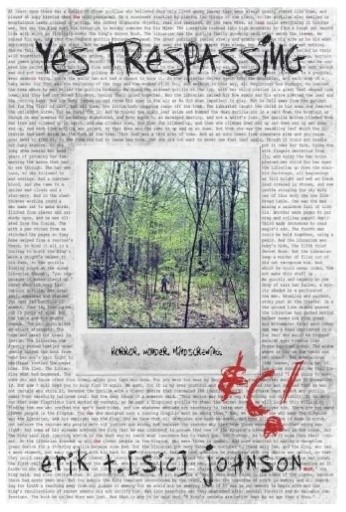
Erik T. Johnson has appeared in numerous periodicals and award-winning anthologies, including the #1 Amazon bestseller, I Can Taste the Blood . Erik’s short fiction collection, Yes Trespassing, was called “electric” by Josh Malerman, international best-selling author of Bird Box and Unbury Carol; THIS IS HORROR UK wrote: "One of the best, most beautifully written collections of this or any other year. Erik T. Johnson is writing at a level that all authors, new and veteran alike, should aspire to. Because what Johnson has achieved with Yes Trespassing is nothing less than absolute greatness." Visit Erik at www.eriktjohnson.net for frequent updates on his work and apperances, and to follow him on Instagram, Twitter, and Facebook. 

Speaking of Josh Malerman, one of the reasons you need to know about Erik now, is because soon you will know about him anyway, so why not get ahead of the game. Erik and Josh are going to be at StokerCon Librarians Day 2019 to talk about a collaboration they are doing right now. Details on how you can be there to see them live here.

The other reason I asked Erik to participate in my "Why I Love Horror" series is because Erik writes and ponders literary horror. Many of you, my library worker readers, don't always think about horror as a literary genre, but in the hands of writers like Johnson, it truly is. Not only is he an author you need to know about on his own merit, but also, in his post today, you will learn much about the genre, it's history, and its appeal to all types of readers, especially the most literary of the bunch.

He also gives you a perfect list of literary horror authors toward the end of his post.

Finally, I love how this essay accurately captures Erik'c personality. It made me smile to read it, happy I will see him in May.

Thank you to Erik and here is his post.

☠☠☠☠☠☠☠☠☠☠☠☠☠☠

The Writers & Readers of Saturn: Erik T. Johnson on Literary Horror
 
 
“Oh, life! 'tis in an hour like this, with soul beat down and held to knowledge,— as wild, untutored things are forced to feed—Oh, life! 'tis now that I do feel the latent horror in thee!”
          —Herman Melville, Moby Dick: or, the White Whale
  
How Ya Doing?
How ya doing? I’m Erik T. Johnson. If you like this post, you can learn almost everything about me and my work in this extensive interview at Kendall Reviews.
I worship 26 deities from the pantheon called Alphabet. Each day and night, without fail, I do my best to make offerings worthy of their might and magic. That includes this post about why I write literary horror, and the reasons people read it. 
But first, some prefatory explorations into horror as epistemology and the curious thrall of one god not in my pantheon of 26—because he rules the gatherings of all deities, pantheon be damned.  
 
Sure it sounds strange, but, well, see, I am strange and refuse to be anyone but me. I left talking B.S. behind at my last full-time job.   
 
 
Literary Horror as Numinous Knowledge

Our modern English word horror was both born from, and remains twin to, the Latin word horror. The Romans folded several meanings into this word, including “dread” and “religious awe.”
That the present-day and ancient versions of this term point to the same “dread” is obvious. But literary horror fiction’s ability to engender insight into the numinous is generally overlooked (I distinguish “literary” from “genre” horror fiction by the former’s ability to initiate one into unique knowledge through the rites of reading and writing). 
Awe is a special kind of knowledge—terrible, overpowering, too much. A result of experiencing events that transgress a person’s preconceived limits of reality. Awe is a stunned knowledge—a knowing that’s had its head smashed with a giant’s fist, leaving a functional but irrevocably cratered brain in its unforgettable wake. Frequently it’s expressed as a mute scream in the face of actualities fathomable in only the most liminal of senses. I’m thinking of the countless manifestations of evil (an elusive word, slippery as an unctuous tentacle), the amoral or cosmic horrific, and that omnipresent, perilous uncertainty that permeates all life. 
Sure, it can be joyful. But as Rilke writes in The Duino Elegies:
 “For beauty is nothing but the beginning of terrorwhich we are barely able to endure, and it amazes us so,because it serenely disdains to destroy us.Every angel is terrible.”
Good literary horror fiction uses the enigmatic nature of evil against itself. It transmutes this mysterious darkness into an entertaining, thoughtful, and goosefleshy illusion, giving it stability and resolution via skillfully executed narrative (Served straight up, truth can taste a bit like Socrates’ hemlock).
 It also presents knowledge most would rather ignore. It reveals an abyss. Yet many of us are irresistibly pulled toward the awe of its shuddering spirit and unpleasant revelations. We delve as deeply as possible into the terrifying pages. But as I’ll explain, horror’s deep-see diving doesn’t always end in drowning, but the sort of illumination that delights the sun-basking beachgoer.   
The God of Horrible Knowledge

One of Goya’s most horrific paintings: Saturn Devouring His Son. Damn but this is Night of the Living DeadGodzilla, and Repulsion all-in-one—psychological and physical violence and collapse; cannibalism, decerebration, gigantism, rabid hunger, senility, and insanity—seen in the exaggerated, glazed eyes and disheveled aura of Saturn. Even I find it hard to look at for too long. The sexual connotations of the two naked figures are a brass band of distress. Yet there’s no denying it’s an amazing work of art—and horror. 
This terrible, awe-inspiring image was inspired by a tale related in Hesiod’s Theogony (I paraphrase):  
Kronos (ancient Greek for Saturn) was King of All. His wife Rhea was to bear him five gods for children. But before their births, Earth and starry Heaven let Kronos know (on the QT), that he was destined to be tossed from his throne by his own son-to-be, Zeus. So when it was time for Rhea to give birth, he got down between her thighs and devoured each child as they emerged from her vagina, one after the other.  
 In The Iliad, Homer describes Saturn as a chthonic god, driven “underneath the earth and barren water.”(Book 14, lines 202-204 in Richard Lattimore’s translation). In Saturn and Melancholy, R. Kilbansky, E. Panofsky, and F. Saxl wrote that he was “the devourer of children, eater of raw flesh, the consumer of all, who [. . .] exacted human sacrifice; [. . .] he castrated his father Uranus with [. . .] a sickle.” 
But there was more to Saturn than malfeasance and destruction. Although those aspects weren’t forgotten, in Hellenic times Saturn was simultaneously associated with initiation into profound mysteries and the attainment of knowledge far beyond the ken of your average slob. Marcus Manilius, in his Astronomica, held that since the seventh planet faced the sun but was positioned at the other end of Earth’s axis, people influenced by Saturn possessed deeper knowledge because they could see the world illuminated by the sun and as its other face, hidden to the majority (just like skilled literary horror writers and readers). 
This identification of Saturn with extraordinary insight into reality is emphasized by Dante in his Paradiso, where the poet locates the representatives of the contemplative life in the Seventh Heaven—the Sphere of Saturn (Canto 21). 
From my point of view, a myth/belief-system regarding Saturn developed over thousands of years into a firmly established tradition:
That of horror as signifier for experiences of extremely dark events, during which those bold enough to keep their eyes open and wits about them are initiated into a state of uncommonly deep knowledge of what we call “reality.”
This tradition continues today in the form of literary horror fiction.   
I Write Literary Horror
Because:
 
I was long ago initiated into Saturn’s brutal mysteries and will go nanners if I can’t express my knowledge, transmute it into art, and share it with those who get it. 
 
I need to challenge myself to end a story of suffering without destroying hope.
 
Nothing is more honest than the stop of a beating heart.
 
Flight from danger resembles chasing too much for my comfort; prey mirroring the movement of the hunter racing behind it.
 
I want to entertain you and make you think, Hey, I never looked at that in that way before.
 
I need to challenge myself to end a story of suffering without destroying hope.
 
I’m too aware that my body is the scene of my time, the one moving increasingly slow and unstable as the other runs far from my grasp, faster and faster. 
 
I suspect that a more accurate term for my life is my penultimate death. 
 
I don’t want to die feeling guilty for doing nothing good with what I’ve lived and learned. 
 
I fear:
 
That the body is the puppet to a ghost, and all speech ventriloquism performed for reasons other than communication. 
 
Growing up is a euphemism for shutting down.
 
And that I’ve orphaned my child to impending adulthood. 
 
Saturn’s Readers 
Readers who crave literary horror are not your average aficionados of fiction—or poetry (Rimbaud’s A Season in Hell, anyone?). Like literary horror writers, they seek to know the truth, the whole truth, and more than the truth—the truth of the truth, even if that means finding that there’s no such thing. Their reading excursions take them through depths that transgress the everyday to such an extent that they ascend. Their love of reading literary horror lets them enjoy the initiation into profound knowledge of broken, unpredictable, vicious realities—and feel good about it. Pretty remarkable “genre” if you ask me. 
Not all literary horror stories and novels need end in despair. Some of the best such fictions take you through a harrowing journey, but close with a sense that things will be all right—despite a heavy dose of almost painful poignance. To quote the late, great, Lou Reed, you can “pass through the fire to the light.”
Where to start? So many choices! 
Some of my favorites: 
Angela Carter (The Infernal Desire Machines of Doctor Hoffmann); Josh Malerman (Unbury Carol); Michael Bailey (Palindrome Hannah); John F.D. Taff (The End in All Beginnings); J. Daniel Stone (Blood Kiss); Shirley Jackson (We Have Always Lived in the Castle); Brian Kirk (We are Monsters); Michael Rowe (Wild Fell); Victor LaValle (The Changeling); Autumn Christian (Crooked God Machine). 
See Ya!
Horror’s knowledge penetrates the falsity of truth itself—journeys from the Sun to Saturn and back—illuminates even as it inks. For those brave enough, it does so with irresistible tension and release. 
“Release from what?” you might ask.
Just look around and behind you . . . Glance at the headlines. Better still, don’t. 
Pick up one of my recommendations instead. 
And enjoy!

Sunday, October 14, 2018

31 Days of Horror Day 14: Why I Love Horror by Jerry Gordon

Today I have yet another debut author to introduce to you-- Jerry Gordon. Before I get into why you should buy this book for your collections, first here is the cover copy for Gordon's novel, Breaking the World:
In 1993, David Koresh predicted the end of the world. 
What if he was right?
Cyrus doesn't believe in David's predictions, and he's not interested in being part of a cult. But after the sudden death of his brother, his parents split up and his mom drags him to Waco, Texas against his will. At least he's not alone. His friends, Marshal and Rachel, have equally sad stories that end with them being dumped at the Branch Davidian Church. 
Together, they're the trinity of nonbelievers, atheist teens caught between a soon to be infamous cult leader, an erratic FBI, and an epidemic that may confirm the worst of the church's apocalyptic prophecies. With tanks surrounding the Branch Davidians and tear gas in the air, Cyrus and his friends know one thing for certain: They can't count on the adults to save them. 
In his debut novel, Jerry Gordon takes readers deep inside the longest standoff in law enforcement history for an apocalyptic thriller that challenges the news media's reporting of the event, the wisdom of militarizing domestic law enforcement, and the blurry line between religion and cult.
Now let's talk about why you need to know about this author and this book. First, the topic-- cults, based on true events, the anxiety and terror built into the subject matter; this is a plot ripe for some wide readership.

But, it would all be for naught if he didn't pull it off. Don't worry, Gordon does. He is a rising talent you should keep your eye on.

Second, this book is published by Apex. Not only do they put together a good physical product that stands up to multiple checkouts, they also know how to spot talent. Don't believe me on that? Well, they were the first to publish Rebecca Roanhorse and look at her now.

Here are two quotes from authors I know and respect singing Gordon's praises for this particular book too:

"The things we do to each other are more awful than any haunted house, ghoul, or demon could ever be, and in BREAKING THE WORLD, Jerry Gordon delivers an unflinching look at real-life horror. This novel will gnaw its way through your skull, burrow into your brain, and mess with you in the best way possible. It’s a pitch-black tale of moral ambiguity, with sympathetic characters facing a home-grown apocalypse of twisted faith, fire, and madness. It’s one of the strongest horror debuts in recent memory, which not only entertains but provides penetrating insight into a dark chapter of American history. This is horror done right."– Tim Waggoner, Bram Stoker Award-winning author of LIKE DEATH
An absorbing blend of history and narrative fiction which elevates the Waco tragedy into an unforgettable exploration of society, faith, and truth. BREAKING THE WORLD by Jerry Gordon is a compelling novel that thunders, and challenges, from page one. The characters are genuine, the struggles throughout are powerful, balanced, and thoughtful. The novel’s conclusion and Gordon’s ideas within do what great fiction often hopes to – defies and then transcends what we thought we knew.– Geoffrey Girard, Bram Stoker-nominated author of PROJECT CAIN and TRUTHERS

Now here is Gordon on the dining moment when he fell in love with the apocalypse.

☠☠☠☠☠☠☠☠☠☠☠☠☠☠☠☠☠☠☠

A Love Letter to the End of the World
by Jerry Gordon

I was twelve years old the day I fell in love with the apocalypse. My grandparents were vacationing off the coast of North Carolina and had rented a beach house on the Outer Banks. The house had two distinct levels connected by an exterior set of stairs. They took the main level with the ocean view and gave me the ground floor, nestled behind a sand dune with a pair of small windows facing away from the beach.

In retrospect, it's clear the downstairs was a converted two-car garage, but I was used to living with four people in a one-thousand-square-foot house with a single bathroom. The idea that I would have an entire floor to myself, complete with its own private bath, made it a palace. Sometime after takeout pizza, I wandered downstairs to my new kingdom to watch TV.

I don't remember when the storm came in. As a kid from the Midwest, I’d seen my fair share of abrupt changes in weather. So the sheets of rain didn't alarm me, and I didn't panic when we lost power. I just grabbed a flashlight out of my backpack and started looking for something to pass the time. I found a yellowed copy of Stephen King's Skeleton Crew on a dusty bookshelf. My grandpa had a creepy wind-up monkey, like the one on the cover, and that was enough to pique my interest. I grabbed the book, plopped down on my bed, and started reading The Mist by flashlight.

The novella started with a storm much like the one howling outside my windows. The locals and their squabbles could easily be swapped out for my neighbors’ disagreements back home. And that town grocery store, the one with the floor-to-ceiling glass entrance, my grandma shopped at a place like it twice a week. About the time air-raid sirens from the fictional military base heralded the arrival of the mist, the storm outside my bedroom took a dark turn.

The wind ripped a metal sign off some beach post and slammed it into the side of one of the downstairs windows. The glass didn't shatter, but the clang was loud enough that I almost peed myself. I pointed the flashlight outside but could only see the waterfall of rain coming off the roof. I couldn't even see the stairs.

With no sign of flooding, I hunkered down with my book and flashlight and kept reading. The monsters in the mist scared me, but not as much as the people huddled in the grocery store. I had caring family members that protected me, but like most kids in my neighborhood, I had scary ones too. Drunks. Relatives with explosive tempers. The self-righteous.

For some reason, it's that last group that scared me the most. The self-righteous, in my twelve-year-old experience, were cold, controlling, and deliberate in their judgment and cruelty. As I watched Mrs. Carmody's power over the grocery store's customers grow, I felt the horror of her convictions in my bones. Unlike the monsters in the mist, she was one of us. And that somehow made her scarier. I can still hear her voice calling out for a blood sacrifice, for expiation.

My flashlight started to dim in the middle of the book's terrifying trip to the pharmacy. Scrambling for batteries in the dying light, I'm pretty sure my imagination could've supplied monsters ten times scarier than anything in the book. I scavenged some AA's from a toy in my suitcase and swapped them out for the dying ones. Before returning to the book, I took a few minutes to look around. I told myself I was checking on the storm, which showed no signs of letting up, but I was really looking for monsters. I hadn't heard anyone upstairs in a while. My grandparents must have found a way to sleep, but part of me imagined them lost in the mist.

Returning to the book, I raced back to the grocery store with our heroes for the final showdown with Mrs. Carmody. I didn't feel any remorse when they shot her. I knew that was the only way, just as I knew the people in the grocery store that stayed would die. I held my breath and ran frantically from the grocery store to the car, letting out a huge sigh of relief when we all pulled away safely.

When I got to the last page of the story, I didn't read the open ending as hopeless. I believed Hartford was still out there, untouched by the monsters. We just needed to get to it. I spent the rest of the night with a dimming flashlight, imagining how I would escape with them. 

Years later, I learned that Stephen King wrote The Mist after a huge storm tore up his town. So there's plenty of symmetry to my reading his novella by flashlight in the middle of a tropical storm. I've often joked that God made me a horror fan that night... and Stephen King paid him to do it.

I would fall in love with other apocalypses, Richard Matheson's I Am Legend and Cormac McCarthy's The Road, but you never forget your first love. When it came time to write my first novel, I found the perfect vehicle for both my love of the apocalypse and my fear of people like Mrs. Carmody. I wrote an alternate-history horror novel about the Branch Davidian Church's standoff with the FBI, a story that imagined what would have happened if David Koresh had been right about the end of the world.

I told Breaking the World from the perspective of three atheist teenagers, a trinity of nonbelievers not unlike me when I read The Mist. Dragged to the church by their born-again parents, the teens were trapped between a cult leader, an erratic FBI, and the literal apocalypse. Together, they would struggle to survive the real horrors of the historic standoff and the imagined monsters of the End of Days.

It's hard not to see my childhood love of The Mist shining through the book. The trapped, claustrophobic setting. The sense of being surrounded by forces beyond your control. The dark corners of religion taking a dangerous turn. The real world giving way to the apocalypse. I even wrote that beach house vacation into a small corner of the story.

Many years later, I find myself coming back to the ending of King's novella. I still believe, against all odds and "adult" common sense, that it's a hopeful one. The decision to leave the story open ended gifted me with the freedom to imagine the ending I needed, and it contributed to my desire to be a writer. For me, the end of the world was just the beginning.

********************************

Jerry Gordon is the author of the apocalyptic horror thriller, Breaking the World. He is also the Bram Stoker Award-nominated co-editor of the Dark Faith, Invocations, and Streets of Shadows anthologies. When he’s not writing and editing, he runs a software company, teaches, and longs for a good night’s sleep. You can find him blurring genre lines at www.jerrygordon.net.