Summer Scares Resources

Click here to immediately access the Summer Scares Resource page so that you can add some professionally vetted horror titles into your reading suggestions and fiction collections for all age levels.
Showing posts sorted by relevance for query pulp. Sort by date Show all posts

Thursday, May 16, 2013

STOPPING ALONG THE WAY: A Guest Post by Author John Everson

Today I will part of the Adult Reading Roundtable's Genre Boot Camp at the Naperville Public Library.  I am both a host, as a member of the Steering Committee, and a speaker at today's event.

I am also honored to be introducing our final speaker of the day, horror author and Naperville resident John Everson.

John is an award winning Horror author who I called a "Pulp King" in my book.  Here's how I defined a "Pulp King:"
This heading refers to the fact that they write mainly paperback horror novels. They are the best of the newer generation of these writers; in fact, all of the authors and titles included here are critically acclaimed if not award winners.  Although they each have their own style, all six authors rise above the mass of paperback horror offerings due to their above average character development and their originality in storytelling. They also all use a fairly high level of gore in their stories, incorporate a large coming-of-age theme, and have their protagonists fighting villains both human and supernatural. Finally, it is important to note that these authors can be expected to release at least one, if not more, novels a year and contribute to a few short story collections, all, quite possibly, for different publishers. 

Everson fits this mold. He is an author whose novels should be included in any public library collection that has any horror beyond Stephen King already.  His novels are crazy scary, featuring well developed characters that readers come to love, especially some of the best female characters you will find in paperback horror.  He is also one of the masters of setting an uneasy stage from the first page and then steadily, relentlessly builds the dread and anxiety to a level that literally overwhelms and envelops you as a reader. [For those librarians out there who are not horror readers themselves, I need to remind you that this is a good thing for horror fans].  Everson uses a lot of blood and sex to drive home his chills.

Earlier this year John and I did a book swap.  I gave him a copy of my book (which features him and his work in multiple places) and he gave me a copy of NightWhere for our collection. It is not just me who likes John's novels.  Our copy of NightWhere has been off the shelf since we got it, only returning this past weekend.  I wanted to write a review of the book, but I had to interlibrary loan it in order to get a copy. Speaking of, look for that review soon. In the meantime, NightWhere has also been named as a finalist for the Bram Stoker Award in the category of BEST NOVEL.  See, you really need to check this guy out.

I am honored that Everson took time out of his busy schedule (see below, he is off to New Orleans soon to, hopefully, take home his second Stoker Award) to not only appear at the ARRT event, but also for allowing me the chance to introduce him to a whole new audience of potential readers.  I am also happy to report that while John's books are evil, violent, and terrifying, he is a great guy.  He proves my adage that horror fans are not monsters, we just like to read about them.

I know not all of you could make it to Naperville, so in preparation for the today's event, I asked John if he would share some of his thoughts with my readers, near and far.  

So thanks John and take it away...

+++++++++++++++++++++++++++++++++++++++++++++++++++++++++


STOPPING ALONG THE WAY
By John Everson

I really hate it when people pronounce pithy platitudes like “It’s all about the journey.” (I really like alliteration though).

They just sound so pat, so smug . Would you be out of your comfy chair taking the journey if you didn’t REALLY want to reach the destination?

There is, of course, some truth in the old saw though. Life really is a million little journeys to this, that and the other, and you spend a lot more time getting to any of the goalposts than you do actually enjoying those moments of victory or defeat at the end. So it is important to focus on what’s going on this minute… not to always be looking ahead. I used to be horribly impatient about it all. Still am sometimes, but I find my “zen” a little more often now.

Early in my writing career, I wrote a story about someone who goes nutters while “Waiting for the Mail.” The story was really about me, inspired by my obsessive impatience in waiting for those acceptance (and rejection) letters from magazines for my stories. Back then, I always had a dozen different stories shipped out to all sorts of books and magazines and I was constantly waiting and hoping for a reply on one of them. Every day I spent hours wondering if a good letter was going to arrive in the mail. Every day, I used to talk to my wife on the phone from work in the afternoon and ask “Is there anything for me in the mail?” Sometimes I made her open the notes when they came in, too impatient to wait until I got home from work. More often than not, they were “thanks, but…” letters. But now and then, there was a “Dear John” letter that said “Yes, we’d sacrifice small rodents for the privilege of putting your vile tale into print so 137 people can read it via mail order…”

Obviously, this was long before the age of e-mail and webzines. But you get the drift. I was always impatient about “the score.” It consumed me.

I’m starting to get more patient these days about actually reaching the goalposts… and enjoying the places in between. Don’t get me wrong, I’m still impatient when it comes to the status of my books and stories and I look forward to getting responses from editors (and sometimes I still prod them!). But I’m finding it easier to wait, to enjoy the simple things like listening to Internet radio while having a beer at night in my home office, after a long day at work.

Today I’m giving a talk to a group of Illinois librarians on the topic of my personal “author” journey… and horror fiction. It was an honor to be asked and I’ve been looking forward to this event for several weeks now. It’s at my local library, and I’ll be meeting librarians from all over the region – a wonderful opportunity to introduce them to my work (and hopefully, of course, they’ll then introduce it to their patrons). But part of me hates for it to actually get here… because once this blog is posted and the event begins, the day will flash by in a heartbeat. Sure, I’m a little nervous about giving the talk – what if I stumble, lose my train of thought, face a room full of blank stares? What if nobody laughs at my jokes and they all walk away thinking I’m an idiot? What if I discover at the end of the address that my zipper was open the whole time?

But those are honestly not big concerns.

I’m looking forward to meeting a lot of fellow booklovers, and it will all be great. But it will all be over too soon. Sometimes reaching the destination can be bittersweet, because, to quote another old saw, nothing lasts forever.

Likewise, the upcoming Bram Stoker Awards on June 15th.
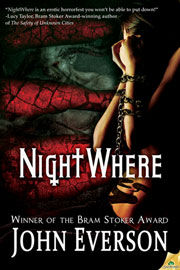
This year, my sixth novel NightWhere, was nominated for a Bram Stoker Award in the Novel Category. Back in 2005, my first novel, Covenant was recognized for achievement in a First Novel, but this is the first time any of my books have been nominated in the general novel category, so naturally I’m excited. The awards are being given out in New Orleans next month, and I’ll be attending the ceremony, but part of me almost doesn’t want the event date to appear. For the past few weeks (and for a few weeks more) I’ve been a Bram Stoker “nominee”! There’s a good feeling to that – almost like, at the moment, everyone on the ballot is a winner. But once the announcements are made, a lot of authors will tighten their lips in a hard smile, and feel loss.

It would be amazing if NightWhere won – this was a novel I first envisioned a decade ago, but was frankly, too afraid to write for a long time. The plot called for it to be an over-the-top extreme, erotic horror novel, and I wondered “what would people think” if I went through with it. Now that it’s been out in the world for ten months with probably the most consistently positive reviews of my career and an award nomination, I guess I have my answer.

But I’m not impatient right now. I’m just happy it was nominated and enjoying the days leading up to the awards ceremony. Whatever the outcome, I’ll toast my fellow writers after the ceremony is done. It will be a great night of fellowship with a lot of people I respect as both writers and friends.

In the meantime, I’m going to enjoy talking books today with librarians – the people partially responsible for NightWhere coming into being, since librarians helped feed my thirst for stories of imagination as a kid. Oh, the hours I used to spend in the library!

So I guess I am enjoying the journey. There’s a story in every stop along the way.

Who needs a destination?

Monday, October 6, 2014

31 Days of Horror-- Day 6: What Are Your Favorite Horror Titles to Share With Patrons [Featuring a Pic of Our Awesome Halloween Display]

Over on the general blog, RA for All, I run a weekly Monday Discussion.  Since this is the first Monday in October, I am running the discussion on both blogs.

Today I want to hear from you about your favorite horror titles to hand-sell to patrons this season. Notice I did not ask you to share your favorite horror book.  That is a different question, which I have asked before.

Rather, what I want to know is which scary books are you most likely to suggest to a patron this season, especially a patron who walks in the door and just wants a seasonal read. What are you giving those occasional horror readers?

Do you have a go-to list of sure bet horror? Or even sure bet "not-quite horror."

I'll go first.

My favorite titles to suggest during this season change each year.  You can check here or here for some ideas from year's past, but this year, I am giving the fans of more traditional pulp horror James Herbert (see this post for why), Richard Layman, or Brian Keene.  The first two are classic horror authors who are no longer alive, the and third is the reigning king of pulp. These are for readers who want that super scary, horror movie type read.

For fans of a lighter touch who just want to experience a tiny bit of terror, I like to give out is The Unseen by Alexandra Sokoloff or The Caretaker of Lorne Field by Dave Zeltersman (both meancing but not bloody) and David Wong's funny, but a bit gross, yet thought provoking John  Dies at the End.

Now it's your turn. Which scary books are you sharing with patrons this haunting season?

Here is a picture of the BPL's horror display, arranged by John, to get you in the mood. Yes, the skeleton is flying over patrons as they walk by.

For past Monday Discussions, click here.

Wednesday, April 13, 2016

New Library Journal Horror Column by Me


The Road to Halloween | The Reader’s Shelf, April 15, 2016

Halloween may be six months away, but a crop of new horror titles are generating huge buzz and are just dying to be checked out now. From tales of monsters to ecological threats to humanity’s darkest souls, these selections will keep patrons primed for the fear-fest to come. 

The biggest release of the genre this spring is The Fireman by Joe Hill (Morrow. 2016. ISBN 9780062200631. $28.99; ebk. ISBN 9780062200655). A deadly fungus is starting to infect humans, causing them spontaneously to combust and sparking the destruction of society as we know it. When pregnant nurse Harper falls ill, her husband attempts to kill her. Luckily, a mysterious hero is there to intervene and takes Harper to a camp where the sick have learned to control the problem. How long will this utopia last? With impressive action scenes, a well-developed cast of characters, and the hope of salvation resting on original MTV VJ Martha Quinn, this read is another menacing win from Hill.

Grady Hendrix has a penchant for 1980s references, as proven in his much-­anticipated follow-up to HorrorstΓΆr, My Best Friend’s Exorcism (Quirk. 2016. ISBN 9781594748622. $19.99; ebk. ISBN 9781594748639). Packaged to look like a school yearbook, the novel tells the chilling story of Abby and Gretchen as they stumble through high school. That is until one fateful night when, after experimenting with drugs, Gretchen disappears. She resurfaces claiming to be just fine, yet Abby can tell things are anything but. Is Gretchen possessed by the devil? Why is no one beyond Abby concerned? Told with Hendrix’s blend of sardonic humor and frightening dread, this is one scary tour down memory lane.

LaValle is the reigning king of ­literary horror and his new novella, The Ballad of Black Tom (Tor. 2016. ISBN 9780765387868. pap. $12.99; ebk. ISBN 9780765386618), is set in New York City during the height of the Jazz Age. Tommy is a dutiful son caring for his dying father and making money by hustling wherever and whenever he can. Dressed in his best clothes, he leaves his Harlem residence with an old book, intent on returning with a ­wallet full of cash. But Tommy’s trip is to the home of a sorceress and his book is the key to awakening a dark magic. He must now navigate the very real threat of racism and the supernatural evil out to destroy everything he holds dear.

In Security (Algonquin. 2016. ISBN 9781616205621. $25.95; ebk. ISBN 9781616205973), the violent, bloody, sexy debut thriller by Gina Wohlsdorf, readers witness events as they unfold as seen through security cameras deployed throughout Manderley Resort. The footage is delivered to a bank of screens watched by a guard. The book quickly switches between the screens and the disturbing story lines taking place across the hotel—at times so fast that the page physically splits into different sections, occasionally requiring the book to be rotated to keep going. This stylistic choice adds tension and unease. With its twisty plot, great characters, and detached tone, ­Security is a tale that will maintain the interest of even the most jaded fan.

World Horror Grand Master Brian Keene brings fear to the ocean’s depths with a brand new story of a monster so petrifying that it makes Jaws look like a goldfish. In Pressure (Thomas Dunne: St. Martin’s. 2016. ISBN 9781250071347. $25.99; ebk. ISBN 9781466882492), readers follow Carrie, a champion free diver, as she works alongside scientists to find out why the floor of the Indian Ocean is collapsing. This ecological disaster is complicated by the nefarious in two forms: murderous, corporate henchmen and a deadly alien that is intent on destroying us all. This frenetically paced, gory novel is filled with action and a protagonist to uphold. Pulp horror of the highest caliber.

While Keene has carried the banner for smart, fun, pulp horror for a while, a new author is rising to help shoulder the load. Last year, Jonathan Janz received accolades for The Nightmare Girl, but his latest offering, Children of the Dark (Sinister Grin. 2016. ISBN 9781944044145. pap. $17.59; ebk. ISBN 9781944044169), is even better. From the first line of the novel, Will, a 15-year-old from rural Indiana, makes it known that he has a story to tell—one about the summer when he watched 17 people die. With a serial killer possessing a surprising connection to Will, a recently awakened ancient evil, a boatload of blood, an intensely driven narrative, and fleshed-out characters, this original work exudes that classic horror feel. A perfect choice for those missing old-school Stephen King.

----------------------------
This column was contributed by Becky Spratford, a Readers’ Advisor in Illinois specializing in serving patrons age 13 and up. She runs the critically acclaimed RA training blog RA for All. You can follow her on Twitter @RAforAll

Thursday, October 2, 2025

31 Days of Horror: Day 2-- Why I Love Horror by Nat Cassidy

Welcome to the first Why I Love Horror essay of 31 Days of Horror 2025. Today I am featuring Nat Cassidy. Why is he first and today? Many reasons.

First, Nat is a readalike for Clay McLeod Chapman in WHY I LOVE HORROR: ESSAYS ON HORROR LITERATURE, and this year, I am featuring a few of the readalike authors here on the blog.

Second, Nat is the author of one of the best Horror books released this year. Not so far. This year, end stop. I have enjoyed all of Nat's books but When the Wolf Comes Home is his best so far.  

I have a lot more to say about it at this link from my Library Journal starred review, but here is a preview of what you can find there.

Three Words That Describe This Book: the power of fear, immersive terror, pulp homage

After a particularly bad day at work at a 24-hour LA diner, aspiring actress Jess finds a young boy whimpering outside her apartment complex and brings him inside. But this is no ordinary boy, and the father who is looking for him is a monster who will stop at nothing to get him back. So opens Cassidy’s latest Horror novel (his best to date), as he consciously frames his story about “daddy issues” as an homage to classic pulp Horror and chase novels with clear Twilight Zone influences, but this description only scratches the surface. Full of action, adventure, blood, and twists, the tale is anchored by the evolving relationship between Jess and the kiddo, who are the beating heart at its terrifying center. Reader beware, as the text warns, “No one will be spared,” but not in the way anyone will anticipate. The horrors encountered here will burrow much deeper, forcing a confrontation with the power fear holds over all. 

Nat also graciously agreed to do an interview with me in LJ to be paired with that review. You can access our conversation here.

Third, today is Yom Kippur. I wrote this post a few days ago and set it to run today. I will not be online as I observe the most important Jewish Holiday of the year. Nat himself is Jewish and he wrote about it in the afterward for Nestlings and how his Judaism made its way into the story. Click here (and scroll down) to read my review of Nestlings where I write about this in more detail.

Thank you to Nat for not only agreeing to write an essay for this year's 31 Days of Horror but also for managing to both make his writing style and personality shine and still give us a serious look at Horror. This is funny on the surface, but the second you start thinking about the words, you realize it hits much deeper.

Take it away Nat Cassidy.

πŸ’€πŸ’€πŸ’€πŸ’€πŸ’€πŸ’€πŸ’€πŸ’€πŸ’€πŸ’€πŸ’€πŸ’€πŸ’€πŸ’€πŸ’€πŸ’€πŸ’€πŸ’€


WHY I LOVE HRUH

By Nat Cassidy


Roughly 135,000 years ago, a young hominid named Hruh lived amongst a tiny, isolated clan deep in the wilderness. 


Hruh was an imaginative, anxious fellow and, much to the chagrin of his small community, he voiced those imaginative anxieties to everyone within earshot. He would think of the worst case scenario—worse than worst, because he would embellish details, exaggerate threats—and then inflict the what-ifs upon his mother, his father, his siblings, his cousins.


It had been this way ever since he first learned to communicate. It didn’t win him any friends. He was often, to borrow a later parlance, on thin fucking ice.


In fact, his name meant something like nuisance, annoyance. It had come from the squealing noises he’d made as a baby, but as any of his family would have attested, the morbid ramblings he spouted off once he got a little older were no less obnoxious than his infant shrieks.


No one wanted to hear it. They cursed the very existence of their limited language for making Hruh’s awful stories possible. You’re making us worry about things that don’t even exist, they’d say (and I’m paraphrasing here). The world is scary enough! Leave those obnoxious details out of it. It’s not useful!


Useful was the most important concept to Hruh’s family. They didn’t have these particular words to describe themselves, but his was a family of stubborn rationalists. A peculiar breed that has been with our species since time immemorial. One that puts no value on the ephemeral.


Hruh couldn’t help himself. He’d never admit it, but a deep, intrinsic part of him actually enjoyed the sensation of jumping at shadows, of causing alarm in others, of looking into the dark recesses of a cave system or a copse of trees and imagining the most hideous breeds of creatures his mind could conjure and then being weirdly relieved when reality served up something a little less insane. It was fun. And it was useful. He didn’t know how, but it was.


Then one day, the monster arrived.


Something somehow none of them had ever seen before.


A massive—they didn’t quite have the word for it, but let’s say cat. With two gigantic teeth the size of a grown man’s forearm jutting out of its skull. And a horrible case of mange, which had rendered its face, neck, and head completely hairless. It was a truly abominable, uncanny sight. Very much like something Hruh’s feverish imagination would’ve conjured up. It glided into Hruh’s family’s cave with silky grace, unhurried, a low and almost hypnotic bass note churning in its throat.


Practically each member of Hruh’s clan had the same response when they saw this abomination: they were stunned into stillness. Their brains were like a narrow entryway, trying to admit too many new thoughts in at the same time, causing a pile up at the threshold.


Hruh’s brother tried to put up a fight, but he was quickly dispatched by one of the monster’s massive incisors. After that, everyone else seemed to accept their fate almost immediately. Only their bowels and bladders had sense enough to run.


Some 134,947 years later, a British writer named Richard Adams would name the sensation tharn (which, incidentally, was Hruh’s clan’s word for a small, purplish berry that should only be eaten when one’s bowels moved stubbornly slow). Hruh would never get the chance to read Richard Adams—a shame, since everyone should give him a try—but he would’ve recognized the concept of tharn immediately. He saw it embodied with every one of his clansmen.


Not him, though. The freakish, naked tooth-cat inspired no such reaction in him.


Because Hruh’s first though of seeing this creature, hearing its rumble, seeing the way the shadows of the cave and their small fires twisted and warped the animal’s already terrifying features, was:


I’ve been here before.


He experienced no overwhelming, circuit-frying novelty. He simply recognized the threat for what it was. He’d played out scenarios like this again and again in his mind. He was afraid, but fear was nothing new to him. He knew how to live alongside it.


Fear had also shown him every place in the caves where he could hide during such an incident as this. He was able to stay safe as the beast slinked past, tore the others apart, and eventually left. 


It all happened so quickly. 


He was the only survivor.


After leaving the mangled remains of his clan—and I suppose it should be said he did feel bad about not being able to save them—Hruh eventually went on to find a new community. 


He wandered far, and one day found others who were like him, who weren’t afraid of fear, who leaned into the even-worse-worst-case-scenarios, who found themselves comforted by the darkest imaginings. Hruh was determined to keep his new clan safe, to not make the mistakes his previous family made. He made story-sharing a priority. Every night—and sometimes during the day. 


The darker the better. 


The scarier the better. 


The more useful. 


It became a tradition. A skill.


And his children lived on.

***

Lately, I’ve been formulating a hypothesis. 


Horror, as a genre, is such a massive tent. We’ve got invisible demons rubbing shoulders with city-sized monsters while unkillable masked slashers shoot the shit with mournful ghosts. It’s a fool’s errand to make too many generalizations.


But my hypothesis is a generalization. And a pretty accurate one at that, I’d wager.


Here it is.


I think almost every horror fan—and this includes horror creators, since all of us come to the genre as fans first; why else would we own so many black t-shirts with Dario Argento titles on them?—possesses two distinct personality traits. 


First, we’re all anxious as hell. We all tend to imagine how things can go wrong. We walk into a room and we’re automatically writing the first draft of some new Final Destination-type movie in our head: here’s what could kill me, here’s what could maim me, here’s where a masked psycho could hide, here’s how I could embarrass myself, here’s how my heart could break. The world is an amusement park map, only it’s full of emotional and physical peril instead of rides.


That’s a big part of why we love our genre so much, after all. Horror stories give us such satisfying confirmation. I was right! we get to think. See?! THAT’S why I never go upstairs / into the ocean / near abandoned lunatic asylums / home to visit my parents!


As a little bonus, we get to feel some justifiable bravery, too. Because, this time, we chose the danger. We didn’t wait for it to come to us. We bought the ticket. We opened the book. You don’t get to rule my life, Fear.


Horror lovers know anxiety like their closest (though not always dearest) friend. But there are plenty of people who are naturally anxious, and a lot of them hate horror. They say things like, Why would I ever want to watch or read something that scares me? The world is scary enough as it is!


That’s where the second trait comes into play. The trait that truly sets us horror fans—the children of Hruh—apart.


We’re all optimists. Whether we’re aware of it or not.


This doesn’t necessarily mean we think good things will happen. But I do think it means we all think good things are possible.


The anxious people who don’t like horror don’t like horror because it only reminds them that bad things happen, with no additional benefit. But every time a horror fan engages with a horror story? A deep, primal part of our brain kicks in, one that thinks (and I’m paraphrasing here), Okay, then how would *I* survive in this scenario? What mistakes do the characters make? What do they do right? 


How can I use this?


Sure, the kills are fun. The dread is delicious. We get a little twisted kick out of the taboo-pushing.


But it’s also all useful.


Horror fans love life. We love living. We understand there is no true horror in a story unless the thing at risk of being lost is precious. We believe survival is always possible, even if it’s only the remotest possibility. And that’s why, night after night, our clan gathers around the fire, to share these stories of failed survivorship, of heightened peril, of gruesome, garish torment. 


Because we’d like to keep on surviving, thank you very much.


We are the children of Hruh, after all. 


It’s in our DNA.

***

By the way, you might like to know that Hruh lived a long, long life and died at the ripe old age of 35.

Anthropological records show he might have even been working on one dilly of a cave painting. Something involving small town secrets, plucky children, and maybe even a killer trickster with a white face and orange puffy hair (but I’m paraphrasing here).


He’d never know the legacy he’d leave behind.


All the imaginings his lineage would conjure forth and inflict upon their stubbornly rational, appalled brethren with morbid glee.


Hruh went on to have a long line of inheritors. 


One of them is me.


One of them is you.

***


Book Cover-- a mottled gray and white background with a tall and long black figure with claw like hands. It is black and ominous with a tiny head, Not too scary, just ominous. on its left, it is holding the hand of a small black human figure who is leading it confidently. Overlaid is the title- WHY I LOVE HORROR (1 word per row). The letters are in a dark gray but the letters that overlap with the monster are in red. In the top right corner it says "Edited by Becky Siegel Spratford" And down in the bottom right in the space just above where the monster and figure are holding hands it says "Essays on Horror Literature."
Click here for more
Why I Love Horror,
in book form 

Saturday, October 15, 2016

31 Days of Horror: Day 15-- Guest Post on Creating Better Horror Displays

Today’s post was directly solicited by me from a librarian I met on Twitter--


Vantine takes displays very seriously and she enjoys horror, so I persuaded her to share some of her horror related display expertise with everyone. What follows is not only a good post for 31 Days of Horror, but also it is just darn good advice for displays all year long.

Take this quote from below as proof-- "Mix up titles, regardless of genre, and let your patrons find books that they would otherwise miss. “ Yes!

Thanks to her for sharing her expertise.

Click here to see more from Vantine on Twitter and read the entire post below.

*******************************************************

In October, we all set up displays of horror books for Halloween. The rest of the year these titles sit alone and unloved, waiting for October to come around again. This is a misuse of the opportunity that book displays present which is to passively help patrons find books they will love that they might not have discovered on their own. By narrowly focusing your display on the genre, you allow some patrons to walk on by because they don’t think they read horror (or science fiction or romance, etc.). The job of the display is to help patrons discover books that they will love, even if they “don’t read” those sorts of books. 

While patrons may say that they don’t like to read horror, they are interested in the themes that horror explores - unhappy families with secrets, the dark side of religion and belief, medical science gone wrong, natural disasters. On RA for All, Becky uses the term appeal factors in her reviews to pluck out the themes that are present in the book. Those appeal factors cross genres and are really what patrons pick up upon, even if they don’t use those words to describe what they like. 

Horror can be tough to sell readers on because they have preconceived notions of what makes a book part of the genre. With psychological thrillers and suspense novels appearing so often on the bestseller lists, I think that it’s a fantastic opportunity to introduce patrons to horror because they share so many of the same appeal factors. A themed display is just a way to direct their attention to what a book has in common with books they might be more familiar with even if it’s nothing they have heard about. 

Don’t prejudge what your patrons will be interested in. Displays should be for your patrons but realize that they will constantly surprise you. Books may not circulate because no one is aware they are part of your collection. Displays are really just a way to shine a temporary spotlight on a few items. One example I have from this summer is a display filled with fiction and nonfiction in honor of Pakistan’s independence day which emptied out in a week. There was nothing in particular that happened in the news or locally that would have drawn patrons to the display. 

Use popular culture to draw attention to your collection and to help you learn to mix up titles. There are many people watching The Walking Dead who don’t think of themselves as horror fans. Titles like The Newsflesh Trilogy by Mira Grant would appeal to fans of the show if they were aware it existed. A great Walking Dead display could focus on the dystopian themes of the show and the abuses of power that can occur when there is a vacuum of power. Mix in some literary and historical fiction with books about dictators along with some zombie books. Walking Dead  graphic novels will draw attention, allowing people to discover the other books.

 Another example is the show Stranger Things on Netflix which  is very popular right now. Technically, it straddles the line between horror and science fiction with pulp elements.  The show includes: horror, humor, nostalgia with secret government plots, missing children, and supernatural forces. Throw up a display of books with pulp themes, 80’s pop culture, scary children with strange powers, and add some 80’s movies on DVD. Even if you are unfamiliar with some or all of these, I guarantee there are book lists out there that can inspire you. Searching for “Stranger Things read alikes” uncovers lists from libraries, bloggers, and book review sites. 

I set up displays mixing literary fiction, romance, horror, mysteries, young adult fiction, non-fiction and thrillers. I try to include audiobooks and graphic novels when possible. Put up displays of juvenile materials near your adult collection. Stick non-fiction themes like crafts and cooking in fiction. People get set in their ways and sometimes visit the same parts of a library over and over again. This is especially important if you shelve your materials by genre. Your displays can help them remember that there are great books hidden in the other corners of your building.

Mix up titles, regardless of genre, and let your patrons find books that they would otherwise miss.