Summer Scares Resources

Click here to immediately access the Summer Scares Resource page so that you can add some professionally vetted horror titles into your reading suggestions and fiction collections for all age levels.

Tuesday, October 15, 2013

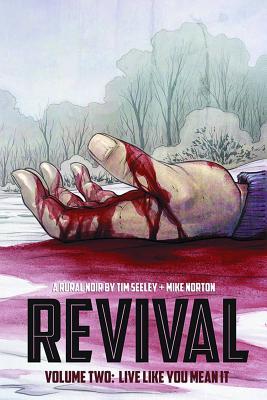
31 Days of Horror: Day 15-- Review: Revival Volumes 1 and 2


Today I am going on a slightly different path for the reviews.  I recently read Revival by Tim Seeley and illustrated by Mike Norton.  I was introduced to this graphic novel by the head of the ARRT Genre Study and now incoming ARRT Chair [2014-15], Annabelle Mortensen who is also librarian at Skokie Public Library. [You can follow her rants and raves on the blog Well-Read].

So anyway, I am going to have her introduce this "new to me" series. Take it away Annabelle...


BECKY! You’re not familiar with the graphic novel Revival? I’m aghast. First, I’m amazed I’ve actually read a book you haven’t. (You read everything). Secondly, this is right in your genre wheelhouse: Undead hordes? Check. Midwestern mystery? Yes. Cool artwork, black humor, steely female characters … need I say more?
Okay, I’ll say a little more. Revival, written by Tim Seeley and evocatively drawn by Mike Norton, isn’t pure horror—although it features many horror elements, its creators bill it as “rural noir.”  Think Fargo meets The Walking Dead with a soupçon of Stephen King. The intent isn’t to scare as much as reveal the sometimes sordid underbelly of small-town life—in this case, Rothschild, Wisconsin, where on a single day the recently dead came back to life, seemingly intact and ready to resume their normal routines.
The story begins the day after “Revival Day.” Quarantines are called and everyone from religious fundamentalists to the CDC and mass media are clamoring at the borders. Dana Cypress is the police officer assigned to the “revivers,” and she soon learns that some are not as normal as first hoped (a revived old lady who stabs her own daughter in the throat takes care of that notion). Then Em, Dana’s younger sister, reveals that she’s a reviver herself, having been murdered by an unknown attacker days earlier.
Although Dana and Em emerge as the central protagonists, Revival is very much an ensemble piece with multiple mysteries throughout—exorcism, incest, paranoia, grave robbery, family secrets, political shenanigans, creepy ghost-y things and much more. Norton’s visual storytelling is top-notch, providing a great sense of atmosphere and images that are unsettling but not over the top. Every character has an agenda, and part of the fun is figuring out just what the heck is going on—you feel just as off-kilter as Rothschild’s residents as the slow-burning tension builds. (Be advised that readers who love a fast pace may lose patience.  Also, it does take some effort to keep the complex plot threads straight. Two trade editions of the series, covering issues #1 to #11, have been released thus far, and there’s a benefit to reading them back-to-back.)
Like Locke & Key (a Becky-approved favorite), Revival is not intended for an open-ended run—Seely and Norton have estimated that the story will continue for perhaps 50 issues. I’m eager to spend more time visiting this weird and wonderful Wisconsin town and reading more of what I think is the most entertaining comic being written today.

Thanks Annabelle.  I totally deserved that. I can't believe I missed this series.  Annabelle introduced it, so I am only going to talk about my feelings about it as a "horror" graphic novel.

I agree that the frame, characters, and setting are great.  And the drawings really enhance the overall feel of the story.  They all have a washed out feel.  The colors are muted; there is a lot of gray and white, except when there is blood...bright red blood!

The over all story has a supernatural edge beyond just the few people who have come back from the dead (fairly intact and seemingly normal, note I said fairly and seemingly). There is also a specter haunting the woods whose purpose is as of yet unknown.

But the overall drive of the story is the crime fiction angle.  This is a supernatural crime story with an overwhelming sense of dread. I would suggest it for all dark, crime fans and people who are interested in looking for a zombie story with an original twist.

I loved the many well rounded characters and multiple plot threads, but some may be a bit confused.  Just remember, this is the beginning and we are still being introduced to everyone, the world they are functioning in, and the major thrusts of the story.

Thanks Annabelle.  Revived  is a series I will return to (pun intended).

Three Words That Describe This Book:  supernatural mystery, strong female characters, unsettling

Readalikes: Annabelle mentioned Locke & Key in her review.  That is much more true horror.  Revival is crime with supernatural/horror elements.  I would say it is much more like another favortie of mine, Chew.  Click here for my reviews of that series.

Other dark crime graphic novels I would suggest are:
Revivial's set up is very similar to that in The Returned by Justin Mott.

Also, The Leftovers by Tom Perrotta is kind of like the bizarro version of Revival.

Also check out this list of rural noir from RA for All.  From Breaking Bad to Winter's Bone, this is a subgenre that is growing in popularity.

Monday, October 14, 2013

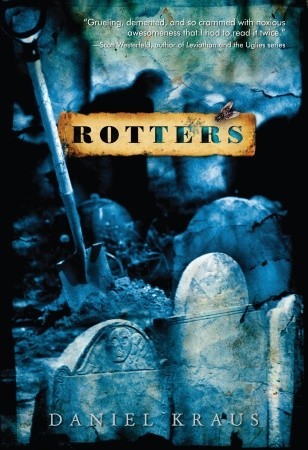
31 Days of Horror: Day 14-- Review: Rotters

Rotters by Daniel Kraus is one of those books I have always meant to read but never quite got to.  I already knew it was considered one of the key examples of horror for teens today. I have given it out to dozens of satisfied teens and even an adult or two. I always had something else waiting in the wings that I HAD to read because I didn't know enough about it.

But, when Kraus agreed to be a part of the Booklist week here on 31 Days of Horror, after calling me out this summer for not having read Rotters yet, I knew I needed to make it a priority.

I am glad I did. But I have to say, although this book is very dark and gory at times, it is not full out horror in the traditional sense.  What I mean is that in Rotters the monsters are very real. They are people, not vampires or zombies.  But I am getting ahead of myself.  Here is the publisher's summary:
Grave-robbing. What kind of monster would do such a thing? It's true that Leonardo da Vinci did it, Shakespeare wrote about it, and the resurrection men of nineteenth-century Scotland practically made it an art. But none of this matters to Joey Crouch, a sixteen-year-old straight-A student living in Chicago with his single mom. For the most part, Joey's life is about playing the trumpet and avoiding the daily humiliations of high school.
Everything changes when Joey's mother dies in a tragic accident and he is sent to rural Iowa to live with the father he has never known, a strange, solitary man with unimaginable secrets. At first, Joey's father wants nothing to do with him, but once father and son come to terms with each other, Joey's life takes a turn both macabre and exhilarating.     
Daniel Kraus's masterful plotting and unforgettable characters make Rotters a moving, terrifying, and unconventional epic about fathers and sons, complex family ties, taboos, and the ever-present specter of mortality.
That's the set up. Here is more about why you would enjoy reading it (or not).

So that macabre turn his life takes, well, his dad is a grave robber.  Joey not only loses his mother and is sent to live with a Dad he doesn't know, but that Dad is gone all the time.  Add to the fact that he is getting bullied at school, and Joey quickly becomes lonely.

Once he figures out what his Dad does when he disappears, things change for Joey. His Dad teaches him the ancient art of grave robbing. The story that follows is Joey's coming of age. As he embraces the Digger life, Joey descends into darkness, but it in this world of death and crimes he is finally finding a place to fit in.

The story then begins its slow spiral downward, as Joey's life turns more away from that of a normal high school boy and into a world of crime and decomposing bodies.

As I said above, there is no supernatural element here, so technically it is not horror.  But like a horror novel, the pacing starts slow and the tone dark.  It as it builds to become more tense and dark, the pacing follows suit.  The last 50 pages are a roller coaster ride ending with a violent finish.  But rest assured, this a a YA novel so Joey is able to move on at the end.

It is important to note that there is a huge subplot involving Joey being bullied at school.  It is bad bullying but he exacts a pretty horrific revenge. This subplot firmly places this novel in the YA realm.  Me, I could take that or leave it, but teens will love it.  They will root for Joey the outcast as he gets the bullies.

The 2 main appeal factors here are the frame and the characters.  Let's start with the frame.  There are A LOT of details here about grave robbing, grave digging, and decomposition of bodies. If you are already a horror fan, this is no big deal.  If you are squeamish and enjoy more psychological horror, this book is not for you.  Personally, I thought the detail was worked into the story very well.  Everything flowed; it didn't feel gratuitous.  The details of "Rotters" and "Diggers" were woven into Joey's coming of age story.  We learn the ropes along with him, and even though Joey makes bad choices, we are so caught up with him in this dark, macabre world, that like him we too go along with the grave robbers without putting up much of a fight.  We too get sucked into the world, the danger, the storied history of grave robbing, etc....

The characters are amazing here as well.  I have mentioned Joey a bunch but all of the characters are very well drawn.  I want to especially point out Boggs, the overall villain of the story.  He is bad, bad, bad.  Kraus paints his reeking, decaying, vileness excellently.  You can smell his evil.  This is key to making the story more than just gross. Kraus' skill with Boggs make is frightening.

Overall, this is an excellent YA novel especially for fans who like their stories dark and gruesome but thought provoking.  There is no supernatural here, so it might also be a nice choice for readers who like crime fiction, but there is plenty of tension, darkness, and gore to satisfy most horror fans.  It is scary because it all could happen.

Three Words That Describe This Book: grave robbing, bullying, character centered

Readalikes: There are a couple of directions you can go here for readalikes.

If you want to read more novels with "bullying" try the classic The Chocolate War by Robert Cormier.

If you want more orphaned kid with some grave robbing thrown in try the Alex Award winning The Good Thief.

If you just want more great creepy stories.  The Graveyard Book by Neil Gaiman is one of the best books I have ever read.  It again has the orphaned kid angle, lots of graveyard scenes, ton of tension, and a compelling plot.

If you specifically want critically acclaimed teen horror, without matching any other appeals I would highly suggest:
Finally, check out Monster Librarian's teen horror page for more ideas.

Sunday, October 13, 2013

31 Days of Horror: Day 13-- Review and Give-Away: Limbus, Inc

Time for a break in the guest posts for me to have 4 days of reviews on some horror books I think are worth your time.  I have a new book, an easily available backlist title, a graphic novel series and one old, out-of-print gem suggested to me by another, non-horror author all coming in that order.

So with that, let's begin with a promising new title in a shared world series by one of my favorite horror publishers (JournalStone), Limbus, Inc.  The set-up here is awesome.  From the publisher:
Are you laid off, downsized, undersized?
Call us. We employ. 1-800-555-0606
How lucky do you feel?
So reads the business card from LIMBUS, INC., a shadowy employment agency that operates at the edge of the normal world. LIMBUS's employees are just as suspicious and ephemeral as the motives of the company, if indeed it could be called a company in the ordinary sense of the word.
In this shared-world anthology, five heavy hitters from the dark worlds of horror, fantasy, and scifi pool their warped takes on the shadow organization that offers employment of the most unusual kind to those on the fringes of society.
One thing’s for sure – you’ll never think the same way again about the fine print on your next employment application!
Who are those five heavy hitters? Well three of them are HUGE; authors whose novels you should already have on your library shelves-- Jonathan Maberry, Benjamin Kane Ethridge and Brett J Talley [links to their mentions on this blog including reviews and guest posts].  The other two, I am less familiar with-- Joseph Nassise and Anne C. Petty who also edited the volume [links to Goodreads].

Think The Twilight Zone only with today's sensibilities.  The five tales here are more novellas than short stories.  They have meat on their own, but in the shared world, they take on even more depth. To add to the cohesion, their is a prologue and an epilogue tying it all together.

Each novella could be its own story, but it is the shared world idea that will draw you in or not.  Limbus is a shadowy company.  They look for people down on their luck and match them to the perfect job for them.  These jobs are unique and can entail you traveling all over the globe, even through time and space, and their is no guarantee that you will make it through alive or if you live that you will ever be employed by them again.  There is some seriously deadly fine print here.

I don't want to give away the plots of each tale at all because I really did enjoy each story for different reasons.  If I had to pick a favorite, I would go with Maberry's "Strip Search," but that is because I love the way he writes. Although Ethridge's laid off Salughterhouse worker led tale is pretty darn awesome.

Although this collection is a true sf/fantasy/horror hybrid, the horror elements shine the brightest.  An uneasy atmosphere abounds here and there are some gory scenes. Limbus, Inc. is a must read for fans of today's horror filled with high tension, and some, but not gratuitous, blood and guts.

Since we are dealing with novellas, the writing is tight.  This is not a book that will waste your time.  It flies by but without sacrificing the chills or the character development. And the shared world is very believable, allowing the entire collection to have a feel of one complete novel.

If you are looking for a fast, satisfying read that seamlessly blends the best of old horror with what is so exciting about today's crop of talented scare-meisters, grab a copy of Limbus, Inc. I was happy to see that this book is getting universal praise from readers, especially those who don't normally read horror or story collections.

JournalStone is promising more Limbus tales to come.  I hope so.

GIVEAWAY ALERT: I have an ARC from the publisher, featuring the limited edition cover art [pictured below] to give away.  Email me at zombiegrl75[at]gmail[dot]com to enter.  I will take entries through Noon on 10/18 to select a random winner.  No need to send me mailing info at this time.
This is the ARC cover
Three Words That Describe This Book: shared world anthology, original, high tension

Readalikes: If you really like one of the pieces, run out and read more by that author. I included links to more of their works up near the top of this review.

I recently finished volumes 1 and 2 of the sf/fsy graphic novel Saga by Brian K. Vaughan and Fiona Staples.  In that series, there is an agency that is very similar to Limbus that sends out agents to do dangerous, inter-planetary jobs. 

If you want to read more recent story releases, I have also ordered Four Summoner's Tales for the BPL which while not a shared world, is similar.  Here is the set up:
Four bestselling authors. One hellraising premise.
What if the dead could be summoned from their graves—for a price? What if a quartet of distinctive storytellers took a stab at this deceptively simple idea—on a dare? The answers lie here, in Four Summoner’s Tales, as these acclaimed writers accept the challenge and rise to the occasion—in four brilliantly chilling ways. It’s all in the execution. . .
Here the authors are Kelley Armstrong, David Liss, Christopher Golden and Jonathan Maberry.  I have not read it yet (it is checked out at my library), but I am hearing people say they like it.

Again, I think with both Four Summoner's Tales and Limbus, Inc. the biggest appeal factors are if you are a fan of one of these authors and/or the shared story ideas.  So, for more readalike suggestions, start with a full novel by your favorite author from the collection and move out from there.

Back tomorrow with a YA backlist title to review.

Saturday, October 12, 2013

31 Days of Horror: Day 12-- Kaite Stover

Today I welcome Kaite Stover who is the Director of Readers' Services for the Kansas City (MO) Public Library.  She is also a columnist for Booklist so I thought she would serve as a nice transistion between the Booklist week and the other posts I have planned for this month.

++++++++++++++++++++++++++++++++++


Debatable Horror

Whenever my local horror maven, Kelly Fann, and I get together, we like to bandy about the following horror conversation about books and movies. Kelly *loves* horror. It's her favorite genre. I like it well enough as an adult and really dug it when I was a teen. But I don't read it much these days because I find *other* literature far more horrifying than the traditional fiction and film that falls into that category.

Here's why: It has to do with suspension of disbelief. Kelly's willing to do it, and I. Just. Can't. 
So Kelly jumps and shrieks at zombies/teen slasher movies and I'm laughing cause I think it's funny when barely dressed actors decide it's a good idea to explore the basement at 3 a.m.

I'm covering my eyes and shivering during The Road and Kelly is exploring the nuances of character and observing the camera angles. Or she's laughing at Human Centipede and I'm squinching my eyes and babbling to myself to drown out the sounds.

We love to have this conversation because it leads to an exploration of what scares us and that leads to what we consider horror.

Kelly finds the paranormal elements of horror to be the most terrifying. And I don't. I'm not worried about zombies and vampires. I think The Shining by Stephen is a great book, but it's doesn't scare me. I was terrified while reading Heartsick by Chelsea Cain and The Road by Cormac McCarthy. I'm not frightened of the typical paranormal elements in horror fiction and film because I don't believe in it. I can't get vested in it while I'm reading or watching. I'm the date you *don't* want at the scary movie. Cause I'll just laugh and examine all the CGI and camera angles. 

But I am scared of serial killers, the apocalypse, and sociopaths (that last one probably falls into the horror category). And it's because those things exist or have the potential to exist. THAT is what scares me. I read about serial killers in the news. Global warming and nuclear annihilation are always on the horizon. Sociopaths have locked up human beings for years or tortured them in unimaginable ways. That makes the news, too. 

I need my horror to come with an element of the possible in order to scare me. If an author throws in a zombie, then I feel safe reading or watching. But if the author can show how it rubs the lotion on its skin or it gets the hose again, then I'm going to lock all the windows and watch the front door, Louisville Slugger at the ready. 

Zombies don't want me. But Hannibal Lecter? I'm just his type.
-- 
kaite stover | director of readers' services | the kansas city public library | 14 w. 10th st. | kansas city, mo | 64105 | 816.701.3683 | www.kclibrary.org

Friday, October 11, 2013

31 Days of Horror: Day 11-- Booklist Guest Posy by Joyce Saricks

Today marks the official end of the Booklist sponsored week on 31 Days of Horror. But like any writer worth their salt, I have a transition guest lined up for tomorrow.

Today's Booklister guest post is by Joyce Saricks:
Joyce Saricks, Audio Editor, headed the Readers' Advisory department at the Downers Grove (IL) Public Library for many years. In addition to overseeing our audiobook coverage, she writes the column "At Leisure with Joyce Saricks." But she's addicted to audiobooks; when she's not reading a book, she's listening to one, while she enjoys her hobbies—cooking, walking, and traveling.
++++++++++++++++++++++++++++++++++++++++++++++++++++++
When Becky first asked me to write about a favorite Horror novel for her blog, I was excited. I love Horror! Well, not all Horror but a pretty wide range from M. R. James’s chilling short stories to novels like David Wong’s John Dies at the End, which may or may not actually be Horror but is certainly horrific. (And filled with black humor.) I still remember where I was as I first read the scene in Bram Stoker’s Dracula with Dracula climbing the castle walls, and I still shiver when I think of it. Deciding what to share is tricky; so many possibilities. Also, I like to listen to Horror audiobooks, and until recently, these were few and far between. As the genre has blended, reaching its tendrils outward into Thrillers, Suspense, Mysteries, and more, I benefit. More for me to enjoy, and there’s an elemental pleasure in hearing a scary story that’s so satisfying.

Michael Koryta’s The Ridge contains the elements I love in Horror: a creepy, growing menace; not too much blood and gore; and a style that takes us inside the characters’ minds so everything that happens is intensified—we’re right there participating in it all.  The narrator, Robert Petkoff, does a great job of building the menace and making it personal. 

The mysterious death of a lighthouse keeper in an isolated section of Kentucky (really? A lighthouse in Kentucky? This is Horror; don’t ask) spurs an investigation and the discovery of something very old and very evil loose in the wilderness and bound to the ridge. That’s the basic plot and telling you much more would involve spoilers.

I like the ancient evil theme and the lovely literary motif: characters escape terrible deaths by making Faustian pacts with the devil—a life for a life. And because I experienced the story on audio, I also got spooky music to underline the tension. There’s a wild game preserve in the area, and the various cats sense the presence of evil, and they become a more physical threat—but honestly not nearly as dangerous as what lurks below. Koryta also offers lots of local history—fascinating stuff—to ground his story. 

If you’re a fan of Clive Barker’s Coldheart Canyon, you might also enjoy this. Both feature an ancient evil, rich historical back stories, isolated locales, and really creepy and gritty tones. I knew I couldn’t stop with one book! 

Thursday, October 10, 2013

31 Days of Horror: Day 10-- Booklist Guest Post by Bill Ott

Today's Booklister guest post is by Bill Ott:
Editor & Publisher, has been at for 30 years. In addition to his various management duties, he continues to edit the crime fiction section of the magazine and delights in discovering new hard-boiled writers, particularly those who set their stories in Europe and Asia (where is more than mere window dressing). To get away from books, he attempts to play golf.
++++++++++++++++++++++++++++++++++++++++++++
My Kind of Scary
By Bill Ott

Let’s get a couple of things straight: I’m no Dan Kraus. The really scary stuff in true horror fiction is too much for me. Reading Dan’s marvelous horror novels, Rotters and Scowler, I’m amazed at his talent but so creeped out that I have to skip whole chunks of the story. Sorry. Just can’t do it. When I attended Dan’s reading of Rotters at a bookstore appropriately called “Buckets of Blood,” I was proud of myself for remaining upright (unlike one of my colleagues, who was reduced to swaying back and forth on her haunches—there were no chairs in the room—as Dan gleefully read about rats scampering about in open graves). It started early for me. In grade school at Saturday matinees, sitting in the balcony while my buddies threw popcorn at the creature from the black lagoon, I demurely—and subtly, so they wouldn’t notice—closed my eyes.

I’m not a complete wimp, however. I can take the kind of violence, even the occasional bucket of blood, which one encounters in thrillers and in hard-boiled and noir fiction. Philip Marlowe, after all, never had to deal with giant rodents. So when I think of my favorite scary books, I move out of the horror genre altogether. But that’s not to say Chelsea Cain is for the timid. Cain’s bewitching serial killer, Gretchen (“the Beauty Killer”) Lowell, with whom Portland, Oregon, cop Archie Sheridan has danced a perverse pas de deux through five gut-wrenching, incredibly intense novels, simply loves blood. That’s why she has such a fondness for removing spleens (sans anesthetic, of course). Archie, naturally, is spleenless at Gretchen’s hand (she took his spleen, then spared his life), but Archie is only one of several hapless souls (whose lives were not spared) who have felt the sting of Gretchen’s scalpel. And she’s not the only psycho in Portland who finds spleen removal oh-so titillating. In Evil atHeart, the third in the series, a spate of copycats attempts to emulate the Beauty Killer’s surgical brio (their technique, alas, is sadly lacking). But give the copycats credit: one of them is equal at least to Gretchen’s flair for grotesque homicide. Male readers, in particular, don’t want to know by what body part one undeserving victim was suspended (well, I guess parts would be more anatomically correct).

So I hope I’ve at least partially established my bona fides here. No, I can’t take chainsaw massacres (or ravenous rodents), but I’m down with spleen removal, private-part suspension, and a host of other decidedly unpleasant demises. I heartily recommend Chelsea Cain for anyone, like me, who can take violence, even grotesque violence, but needs the insulation of a character-driven, psychologically complex thriller. No, that last sentence is all wrong. It makes me sound like an NPR type who would never read a crime novel (“too formulaic”) but laps up Mystery! on PBS because it’s “literary.” That’s not me, I assure you. What I mean by “insulation” is that I need a little time to settle my stomach between spleens. Cain gives me that because, between the gory outbursts, she probes the delicate psychological underpinnings of her characters as deeply as Gretchen probes our squishy parts.

Ah, but that annoying Dan Kraus gives the lie to this fancy theory. His books are every bit as psychologically acute and character driven as Cain’s, but I’m still way more scared by Scowler than I am by any of the Cain novels, even Heartsick, the first in the series, in which poor Archie endures the majority of his bodily invasions. Why is that? Maybe because Cain is writing a kind of police procedural, which means she must devote numerous pages to investigatory detail. With Dan’s books, he’s under no such generic obligation, and you never know when the rats are coming next. And when they come, oh my God, you just know that Dan is back there cackling at your terror.

That’s the story. Read Chelsea Cain if you haven’t already; she’s among my favorite thriller writers. And, if you’re made of sterner stuff than I am, read Dan Kraus, too, without skipping any pages. 


Wednesday, October 9, 2013

31 Days of Horror: Day 9-- Booklist Guest Post by Keir Graff

Today's Booklister guest post is by Keir Graff:

Keir Graff, Booklist Online Editor, works closely with the editors of Booklist to ensure a lively rapport between our print and electronic products. In addition to writing book reviews and e-newsletters, he contributes to Likely Stories, the Booklist blog, musing on publishing news and the art of the review. He has written four novels for adults and recently published his first children's book, The Other Felix (October 2011).
+++++++++++++++++++++++++++++++++++++++++
When the Circle Closes . . . You’re Trapped Inside!
When I was younger, I consumed a lot of horror fiction, sometimes in novel form, more often in the form of a video triple feature, an all-night splatterfest in which the iconic cycle of Night of the Living Dead, Dawn of the Dead, and Day of the Dead might end with the actual breaking of dawn outside my windows.
But, while I’ve retained an intellectual fondness for the visceral pleasures of, um, viscera, this affinity has become more and more hypothetical as the years go by. My changing habits might be attributed to becoming a boring, job-holding adult, or to fatherhood (once you’ve suffered projectile-vomiting at the mouth of your one-year-old, Linda Blair’s antics in The Exorcist are merely yawn-provoking). But what’s really happened, I think, is that I’ve become scared by different things.
Overgrown graveyards, fast-moving zombies, houses designed to kill innocent teenagers? Sorry, those are all nothing compared to social media and smartphones—that is, the world we actually live in. And so I suggest you read the scariest book I’ve read all year, a book that is not horror but definitely is horrifying: Dave Eggers’ The Circle.
So it’s a book about a young woman who goes to work at the coolest, hottest, fastest-growning tech company on the planet. How, you ask, is that frightening?
(You may assume it is scary merely by comparison with our own jobs, which is partly true: once you read about The Circle’s super-sweet Bay Area campus, which is Google’s actual campus meets everyone’s idea of what Google’s campus is actually like, you’ll never look at your own company cafeteria with anything but revulsion. But there’s a lot more to it than that.)
Well, The Circle, where young Mae lands her dream job, has cornered the market on search, social media, and e-commerce. They’re digitizing every piece of information you can think of, and a lot more you can’t, meanwhile planting video cameras that cover every square foot of God’s green earth. Oh, and they’re also advocating for a single login that will connect every single aspect of your life, from the shopping you do to to the reviews you write to your mandatory duty as a U.S. citizen to vote in elections (and, just maybe, on what people ought to be having for lunch).
We’ve all watched horror films where someone is running down the road in front of a car, and we’ve all yelled at the screen, “Stop running straight down the middle of the road! Turn right or left! Go into a building!” Which would work, right? Because cars can’t drive inside buildings. But in Eggers’ scary new vision of about ten minutes from now, there will be no escape. No place to run, hide, or avoid annoying pop-ups that demand your instant response. One character does try to drop off the grid and guess what? Well, I don’t want to ruin it for you, but . . . the grid finds him, and it doesn’t go well.
Much horror fiction scares you while reassuring you that, ultimately, you’re safe. This is not that book. In fact, ever since I read it, I feel as though I’ve read dozens of sequels in the form of articles about the latest advances in consumer technology—technology that’s all fine and great until we just can’t turn it off. And, given how many people I see walking around with their handheld screens leading the way, we don’t even want to turn it off. If technology is the vampire that needs to be invited in before it can steal our souls, well, we’ve already given it our spare set of keys.
The Circle is a book that should scare us, that should make us do things differently—but, if we’re going on the record of two other visionary works, Brave New World and 1984, it ain’t gonna happen.
And that’s scary.